Fever Not Going Away? Causes, Warning Signs and When to See a Doctor
 Dr. Sheena Cherry, Specialist in Internal Medicine
14 min read
It is day four. The paracetamol brings your temperature down for a few hours, then the chills come back. You have no appetite, you are tired of lying in bed, and you are starting to wonder: is this still just a virus, or is something else going on?
Most fevers in adults settle within three to five days. One that lasts longer usually has a common cause, often a virus that is taking its time or a bacterial infection that needs treatment, but it is a reason to get checked. Where you have travelled, and whether you have drunk unpasteurised milk, can matter more than you might expect, especially for people living in the UAE.
Fever not going away: the short answer
- A fever is a temperature of 38°C (100.4°F) or higher. Most viral fevers last 3 to 5 days.
- See a doctor if a fever lasts more than 3 days, reaches 39.4°C (103°F) or more, or keeps returning.
- Common reasons for a lasting fever include a bacterial infection (chest, sinus, urine, kidney), dengue, flu, glandular fever and, less often, TB, typhoid, malaria or brucellosis.
- A fever over 38.3°C that lasts 3 weeks without a cause is called fever of unknown origin and needs a planned work-up.
- Get urgent help for a stiff neck, a rash that does not fade, confusion, difficulty breathing, chest pain or a seizure. Call 998 in an emergency.
In this guide: What counts as a fever · How long a fever lasts · Why a fever does not go away · Warning signs · Tests · Causes to consider in the UAE · Home care · FAQs
What counts as a fever?
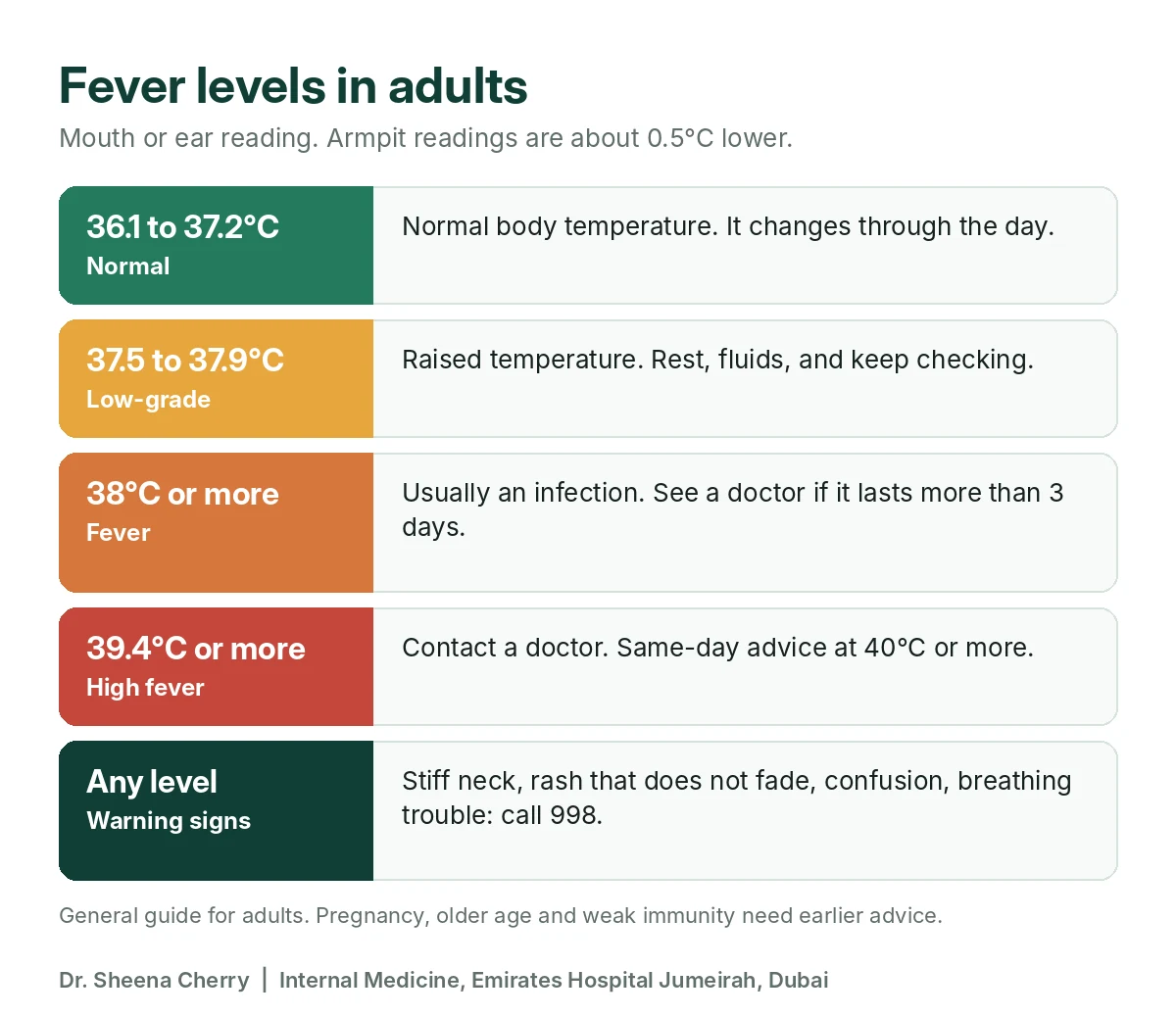
Normal body temperature varies from person to person and through the day, usually between about 36.1°C and 37.2°C. It is lowest in the early morning and highest in the late afternoon. A fever is when your body raises its set point, usually to fight an infection.
| Reading (adults) | What it means |
|---|---|
| 36.1°C to 37.2°C (97°F to 99°F) | Normal range |
| 37.5°C to 37.9°C (99.5°F to 100.2°F) | Raised or low-grade temperature |
| 38.0°C (100.4°F) or higher | Fever |
| 39.4°C (103°F) or higher | High fever: contact a doctor |
| 40°C (104°F) or higher | Very high fever: seek medical advice the same day |
How you measure matters. Mouth and ear thermometers are reliable when used correctly. Armpit readings run about 0.5°C lower, and forehead strips are the least accurate. Wait at least 15 minutes after a hot or cold drink before taking an oral reading.
How long should a fever last?
Most fevers caused by common viral infections, such as colds, flu and COVID-19, last around three to five days. Some infections naturally cause a longer fever, which is why the cause matters more than the number of days alone.
| Cause | Typical fever length | Clues |
|---|---|---|
| Common cold or mild viral illness | 1 to 3 days | Runny nose, sore throat, mild cough |
| Flu or COVID-19 | 3 to 5 days, sometimes up to a week | Sudden onset, body aches, cough, tiredness |
| Dengue | 2 to 7 days | High fever, severe headache, pain behind the eyes, muscle and joint pain, rash, low platelets |
| Glandular fever (EBV) | 1 to 2 weeks or longer | Severe sore throat, swollen neck glands, marked tiredness |
| Bacterial chest, sinus, urine or kidney infection | Continues until treated | Cough with phlegm, facial pain, burning urine, back pain |
| Typhoid | 1 to 3 weeks or more | Gradual rise in fever, headache, tummy pain, recent travel |
| TB, brucellosis, abscess | Weeks | Night sweats, weight loss, joint or back pain |
As a rule, a fever that is still present after three days, or that improves and then comes back, deserves a medical check. A cough or tiredness can linger for one to two weeks after flu or COVID-19, but the fever itself should not.
Why does a fever not go away?
A lasting fever is almost always caused by something common behaving in an unusual way, rather than a rare disease. Doctors group the causes into a few families.
1. A viral infection that runs longer
Flu, COVID-19, adenovirus, dengue and glandular fever can all cause a fever beyond five days. A viral fever can last 7 days, particularly with flu or dengue, but it should be slowly improving by then.
2. A bacterial infection that needs treatment
Sometimes a virus is followed by a bacterial infection, such as pneumonia or sinusitis. Other bacterial causes include urine and kidney infections, dental abscesses, skin infections, an infected gallbladder and, less often, infection of a heart valve (endocarditis). These usually need antibiotics or drainage, and the fever will not settle without them.
3. Infections that classically cause a long fever
Tuberculosis, typhoid, malaria, brucellosis, HIV and cytomegalovirus can all cause fevers lasting weeks. Night sweats, weight loss, recent travel, contact with animals or drinking unpasteurised milk point towards these causes.
4. Inflammatory and autoimmune conditions
Rheumatoid arthritis, lupus, adult-onset Still’s disease, inflammatory bowel disease and vasculitis can cause fever without any infection. In people over 50, giant cell arteritis (headache, scalp tenderness, jaw pain when chewing) is an important cause to rule out because it can affect vision.
5. Cancers of the blood and lymph glands
Lymphoma and leukaemia can present with fever, drenching night sweats, weight loss and swollen glands. These are uncommon causes, but they are the reason a doctor will ask about weight and sweating.
6. Medicines and other causes
Some antibiotics, anti-seizure medicines and other drugs can cause “drug fever”. Blood clots in the legs or lungs, an overactive or inflamed thyroid and, rarely, other conditions can also raise temperature. A thyroid check is often part of the blood tests (read our guide to TSH results).
Fever that keeps coming back
A fever that disappears for a day or two and then returns is not the same as a fever that has gone. Recurring fevers can be seen with malaria, brucellosis (once called “undulant fever”), abscesses, urine infections that were not fully treated and some inflammatory conditions. Keep a simple log of the time, reading and any medicine taken: it helps the doctor spot the pattern.
What is fever of unknown origin?
Doctors use the term fever of unknown origin (FUO) when a temperature above 38.3°C (100.9°F) is recorded on several occasions over more than three weeks and no cause has been found after a reasonable set of tests. Infections, inflammatory conditions and cancers are the main causes, and in a proportion of people no cause is ever found and the fever settles on its own. FUO is investigated step by step, with each test chosen from the results of the last.
Warning signs: when a fever needs a doctor
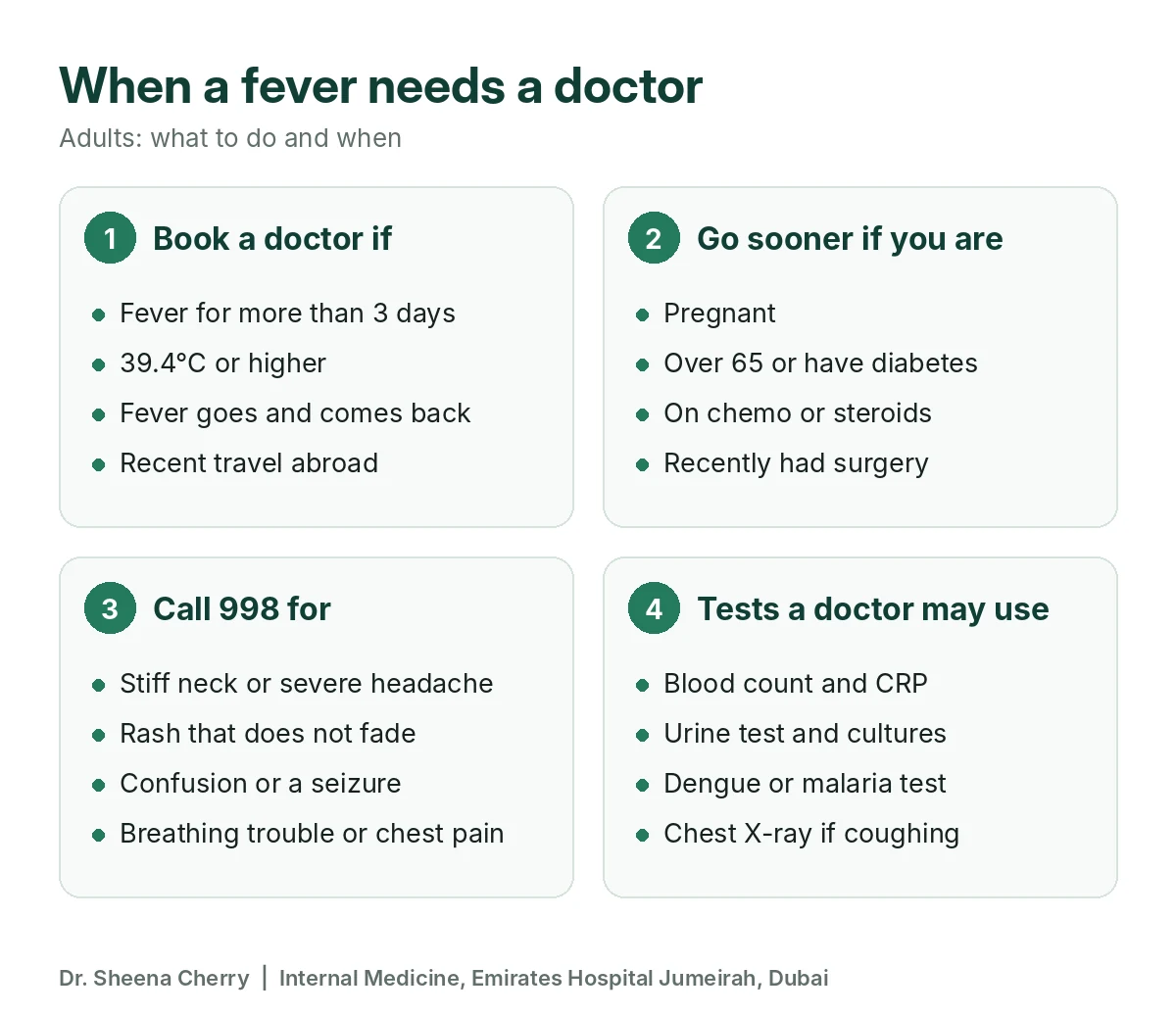
Book a doctor’s appointment if
- Your fever has lasted more than 3 days, or is getting worse
- Your temperature reaches 39.4°C (103°F) or higher
- The fever went away and came back
- You have travelled abroad in the last few months
- You have burning urine, back pain, ear or facial pain, or a cough with coloured phlegm
- You have night sweats or are losing weight without trying
Get help sooner if you are in a higher-risk group
- Pregnant: a temperature of 38.5°C or any fever lasting 3 days or more needs a doctor
- Over 65, or living with diabetes, heart, lung or kidney disease
- Weakened immunity: chemotherapy, long-term steroids, transplant medicines, HIV or no spleen
- Recent surgery or a recent hospital stay
What the doctor will check
Finding the cause of a lasting fever starts with questions. Expect to be asked:
- When the fever started, how high it goes and whether it comes and goes
- Where you have travelled in the past year, and whether you took malaria tablets
- Contact with animals, camels or farms, or drinking unpasteurised milk
- Anyone at home or work with similar symptoms
- New medicines, supplements or recent procedures
- Night sweats, weight loss, joint pain, rashes or swollen glands
A careful examination follows: throat, ears, chest, heart, abdomen, skin, joints and lymph glands. Then tests are chosen to match the clues.
| Test | What it looks for |
|---|---|
| Complete blood count (CBC) | Infection pattern, anaemia, low platelets (dengue), abnormal cells |
| CRP and ESR | Level of inflammation in the body |
| Urine test and culture | Urine or kidney infection |
| Blood cultures | Bacteria in the bloodstream |
| Liver and kidney tests | Hepatitis, typhoid, dehydration, organ strain |
| Dengue NS1 or antibody test | Dengue infection |
| Malaria test | Malaria after travel |
| Chest X-ray | Pneumonia, TB |
| Specific tests | Typhoid, brucella, TB, EBV, HIV, thyroid, autoimmune markers |
| Ultrasound or CT | Abscess, gallbladder or kidney problems, enlarged glands |
Not everyone needs every test. A clear story often points straight to the right one.
Four examples of a fever that would not settle
These show how a doctor works through a fever that will not settle. Your own symptoms need a doctor’s review.
Five days of fever and a worsening cough
A 45-year-old has flu-like symptoms that seemed to improve, then the fever returns with a cough producing green phlegm and pain on breathing in. A chest X-ray and blood tests suggest pneumonia, which is treated with antibiotics.
High fever after a trip home
A 30-year-old returns from a visit to South Asia with a high fever, a severe headache, pain behind the eyes and aching muscles. The blood count shows low platelets and a dengue test is positive. Treatment is fluids, rest, paracetamol and close monitoring of platelets.
Three weeks of evening fevers and night sweats
A 52-year-old has low-grade fevers most evenings, soaked sheets at night and has lost 4 kg. This needs a structured work-up, which may include a chest X-ray, TB tests, inflammatory markers and a scan of the glands.
Fever with burning urine and back pain
A 35-year-old woman has a fever of 38.9°C, burning when passing urine and pain in one side of her back. A urine test confirms a kidney infection, which needs a full course of the right antibiotic.
Causes to consider in the UAE
- Travel. Many UAE residents travel often to South Asia, Africa and Southeast Asia. Dengue, typhoid and malaria are common in some of these regions, so always tell your doctor where you have been, even months ago.
- Raw camel or goat milk. Brucellosis is uncommon in the UAE, but cases linked to unpasteurised milk and contact with livestock are reported. It typically causes a fever that comes and goes, sweats and joint or back pain.
- Heat. In the summer, heat exhaustion can make you feel hot, weak and unwell. Heat stroke is an emergency. Neither is the same as a fever from infection, but they can be confused.
- Flu season. Flu circulates mostly in the cooler months. A yearly flu vaccine lowers your risk of a long, severe illness.
- Diabetes. Diabetes is common in the UAE and makes urine, skin and foot infections more likely and more serious. If you have diabetes, do not wait long with a fever. Our guide to HbA1c levels explains how sugar control is checked.
What you can do at home
- Rest and drink plenty of fluids. Water, oral rehydration solutions and soups help replace what you lose through sweating.
- Use paracetamol for comfort, following the label dose. Ibuprofen is an option for many adults, but avoid it if dengue is possible, as it can increase bleeding risk.
- Dress lightly and keep the room comfortable. Do not use cold baths or ice.
- Keep a fever diary: time, temperature, medicine taken and any new symptoms.
- Do not take leftover antibiotics. They may be the wrong drug and can hide the cause.
- Stay home until you have been fever-free for at least 24 hours without medicine, to protect others.
Bringing the temperature down makes you feel better, but it does not treat the cause. A fever that only stays away while you take paracetamol has not gone.
Common myths about fever
- “You should sweat it out.” Heavy blankets can push the temperature higher and dehydrate you.
- “Antibiotics cure a fever.” Most fevers are viral, and antibiotics do nothing for them.
- “The number tells you how serious it is.” A very high fever needs attention, but a lower fever with warning signs can be more serious. How you feel and the other symptoms matter as much.
- “If paracetamol brings it down, it’s not serious.” Serious infections also respond to paracetamol for a few hours.
How Dr. Sheena Cherry can help
Dr. Sheena Cherry is a DHA-licensed Specialist in Internal Medicine at Emirates Hospital Jumeirah, Dubai. A fever that will not settle can come from the chest, urine, blood, gut or joints, and working through those possibilities is a routine part of internal medicine. She takes a full history, examines you, orders the tests that fit your story and arranges hospital care or specialist referral when needed. Learn more about her approach to infections and acute illness.
Bring your fever diary, a list of medicines and your travel dates to the appointment.
Frequently asked questions
Why is my fever not going away?
The most common reasons are a viral infection that runs longer than usual, such as flu or dengue, or a bacterial infection that needs treatment, such as pneumonia, sinusitis or a kidney infection. Less often, TB, typhoid, malaria, inflammatory conditions or medicines are the cause.
How long is too long for a fever?
For adults, see a doctor if a fever lasts more than 3 days. A fever above 38.3°C lasting more than 3 weeks without a known cause is called fever of unknown origin and needs a planned medical work-up.
Can a viral fever last 7 days?
Yes. Flu, dengue and glandular fever can cause a fever lasting up to a week or longer. You should still see a doctor after 3 days to confirm the cause and check for complications.
What should I do if my fever does not come down with paracetamol?
Check you are taking the correct dose at the right interval, drink fluids and rest. If the fever stays at 39.4°C or higher, lasts more than 3 days or comes with warning signs, seek medical care.
Is 37.5°C a fever?
37.5°C is a raised or low-grade temperature. Most doctors define a fever in adults as 38°C (100.4°F) or higher.
Why does my fever keep coming back?
A fever that returns after a day or two can mean an infection that has not cleared, a new bacterial infection after a virus, or a condition that causes recurring fevers, such as malaria, brucellosis or an abscess. Record the pattern and see a doctor.
Do I need antibiotics for a fever?
Only if a bacterial infection is found or strongly suspected. Most fevers are viral and antibiotics do not help them.
What blood tests are done for a persistent fever?
Usually a complete blood count, CRP or ESR, liver and kidney tests, a urine test and blood cultures. Depending on the clues, tests for dengue, malaria, typhoid, brucella, TB, thyroid problems or autoimmune conditions may be added.
When is a fever an emergency?
Call 998 for a fever with a stiff neck, a rash that does not fade under a glass, confusion, difficulty breathing, chest pain, persistent vomiting, bleeding or a seizure.
Can stress cause a fever?
Stress can make you feel hot and unwell, and a rare condition called psychogenic fever exists. But a measured temperature of 38°C or higher should not be put down to stress until other causes have been checked.
References
- Mayo Clinic. Fever: symptoms and causes
- HSE Ireland. Fever in adults
- NHS. High temperature (fever) in adults
- Roth AR, Basello GM. Approach to the adult patient with fever of unknown origin. Am Fam Physician 2003
- World Health Organization. Dengue and severe dengue
- BMC Infectious Diseases (2016). Human brucellosis notifications in Abu Dhabi, UAE
This guide is general information and does not replace a consultation. Read our medical disclaimer. For an emergency, call 998.
Specialist in Internal Medicine at Emirates Hospital Jumeirah, Dubai. MD in Internal Medicine, Fellowship in Critical Care Medicine and Postgraduate Certification in Cardiology from Johns Hopkins University. About Dr. Sheena