HbA1c Normal Range in the UAE: What Your Result Means
 Dr. Sheena Cherry, Specialist in Internal Medicine
15 min read
HbA1c is one of the most important numbers on a blood test report, and one of the easiest to misunderstand. A result of 5.9% might be flagged as high with no explanation. A result of 6.4% might be printed without any flag at all. And if you already have diabetes, you may have been told to “get it under 7” without anyone explaining why.
The ranges themselves are simple. What causes confusion is the mix of units (% and mmol/mol), the difference between a diagnosis and a treatment target, and the conditions that can make HbA1c read too high or too low. All three come up often in the UAE, where diabetes is common and anaemia and thalassaemia trait can skew the test.
HbA1c normal range: the short answer
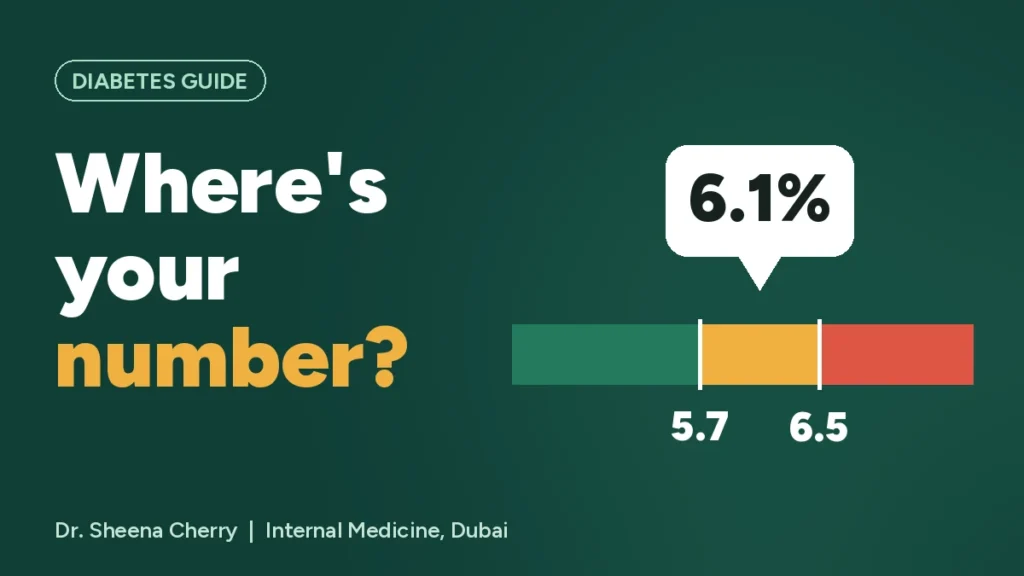
- Normal: below 5.7% (below 39 mmol/mol)
- Prediabetes: 5.7% to 6.4% (39 to 47 mmol/mol)
- Diabetes: 6.5% or higher (48 mmol/mol or higher), confirmed on a second test
- Usual target if you have diabetes: below 7% (53 mmol/mol), adjusted to your age and health
- No fasting is needed. HbA1c reflects your average blood sugar over about the last three months.
In this guide: What HbA1c is · Normal range · HbA1c to average sugar · Targets in diabetes · By age · What affects the result · HbA1c in the UAE · How to lower HbA1c · FAQs
What is HbA1c?
Haemoglobin is the protein inside red blood cells that carries oxygen. When sugar (glucose) circulates in your blood, some of it sticks to haemoglobin. The higher your blood sugar over time, the more haemoglobin becomes “sugar-coated”. HbA1c measures the percentage of haemoglobin that is coated in this way.
Red blood cells live for about three months, so HbA1c gives a picture of your average blood sugar over roughly the last two to three months, with the most recent weeks counting the most. That makes it different from a finger-prick or fasting glucose, which only shows your sugar at one moment.
Doctors use HbA1c for three things:
- Screening for prediabetes and type 2 diabetes in people at risk
- Diagnosing diabetes when the result is 6.5% or above on two tests
- Monitoring how well diabetes is controlled, usually every three to six months
How the test is done
HbA1c is a simple blood test. A small sample is taken from a vein in the arm, or sometimes from a finger prick using a point-of-care machine in the clinic. You do not need to fast and it can be done at any time of day. Lab results are usually ready within a day. For diagnosis, doctors prefer a lab test using a standardised (NGSP certified) method, because finger-prick machines vary more.
Who should get an HbA1c test?
Type 2 diabetes and prediabetes often cause no symptoms for years, so screening matters. The ADA recommends testing:
- All adults from age 35, repeated at least every three years if normal
- Adults of any age who are overweight and have one or more risk factors: a parent or sibling with diabetes, high blood pressure, high cholesterol or triglycerides, polycystic ovary syndrome, an inactive lifestyle or a history of heart disease
- Women who had diabetes in pregnancy, at least every three years for life
- People with prediabetes, every year
- People with HIV or those taking medicines that raise blood sugar, such as long-term steroids
Many people in the UAE fit at least one of these groups, so an HbA1c is often part of a routine check-up here.
Symptoms of high blood sugar
When blood sugar is high enough to cause symptoms, people commonly notice:
- Feeling very thirsty and passing urine more often, including at night
- Tiredness and low energy
- Blurred vision
- Cuts and wounds that heal slowly, or repeated skin, gum or urine infections
- Weight loss without trying
- Tingling or numbness in the feet
Having none of these does not rule out diabetes. Most people with prediabetes and early type 2 diabetes feel completely well.
HbA1c normal range and diagnostic cut-offs
Labs in the UAE report HbA1c either as a percentage, in mmol/mol, or both. These are the cut-offs used by the American Diabetes Association (ADA) in its 2026 Standards of Care.
| Result | HbA1c % | HbA1c mmol/mol | What it means |
|---|---|---|---|
| Normal | Below 5.7% | Below 39 | No diabetes. Recheck as advised if you have risk factors. |
| Prediabetes | 5.7% to 6.4% | 39 to 47 | Higher risk of type 2 diabetes. Often reversible. |
| Diabetes | 6.5% or higher | 48 or higher | Diabetes, if confirmed on a second test or with symptoms. |
Source: American Diabetes Association, Standards of Care in Diabetes 2026. Some countries, including the UK, use 6.0% to 6.4% (42 to 47 mmol/mol) for prediabetes.
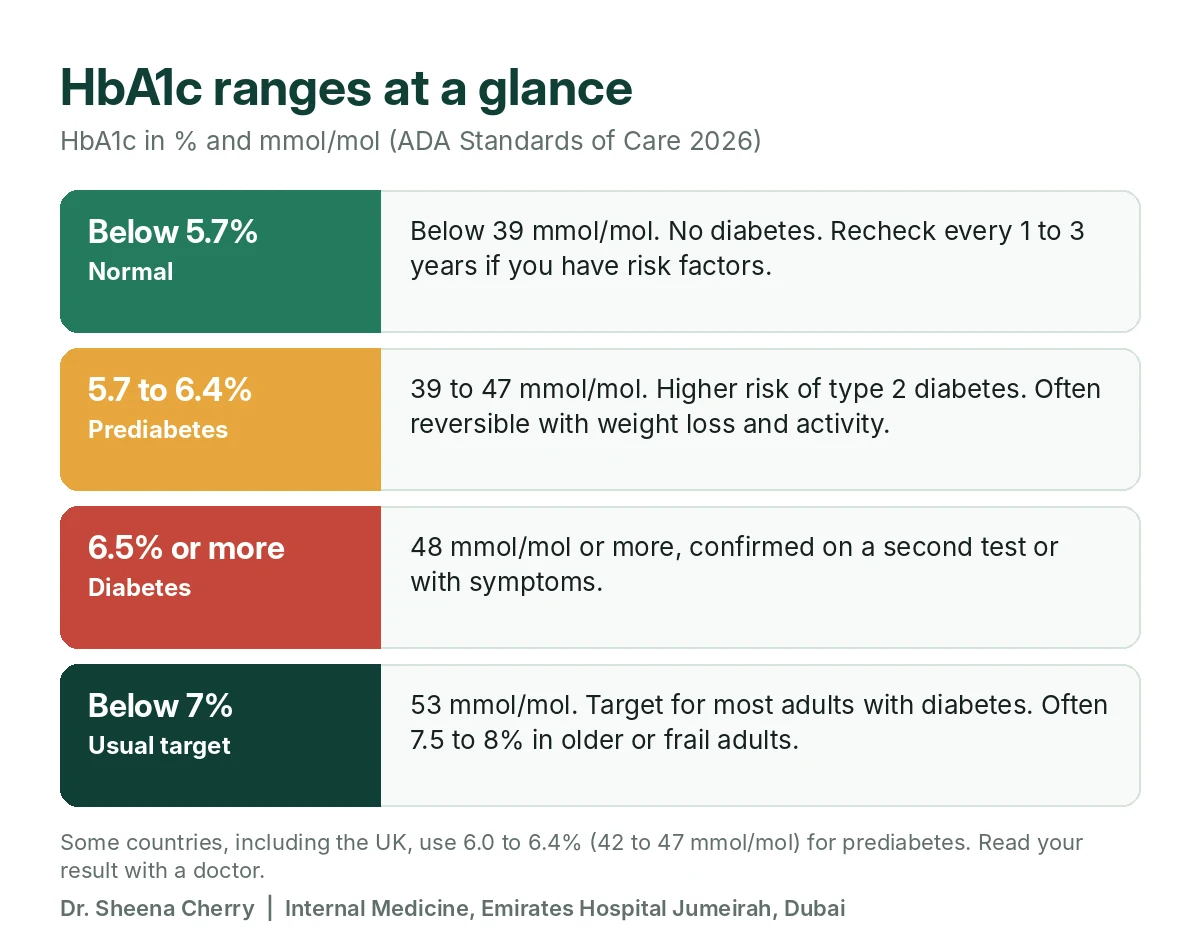
Risk does not jump suddenly at 5.7% or 6.5%. It rises gradually, so a result of 6.3% carries more risk than 5.8%, even though both sit in the prediabetes band.
HbA1c compared with other sugar tests
HbA1c is one of three tests used to diagnose diabetes. Each has strengths, and doctors often use two together.
| Test | Normal | Prediabetes | Diabetes | Good to know |
|---|---|---|---|---|
| HbA1c | Below 5.7% | 5.7% to 6.4% | 6.5% or higher | No fasting. Shows the last 2 to 3 months. |
| Fasting glucose | Below 5.6 mmol/L (100 mg/dL) | 5.6 to 6.9 mmol/L (100 to 125 mg/dL) | 7.0 mmol/L (126 mg/dL) or higher | Needs 8 hours without food. |
| 2-hour glucose tolerance test | Below 7.8 mmol/L (140 mg/dL) | 7.8 to 11.0 mmol/L (140 to 199 mg/dL) | 11.1 mmol/L (200 mg/dL) or higher | Sugary drink, then a test 2 hours later. Used in pregnancy. |
A random glucose of 11.1 mmol/L (200 mg/dL) or more with classic symptoms is also enough to diagnose diabetes.
HbA1c and your average blood sugar
HbA1c can be converted into an estimated average glucose, which helps if you check your sugar at home or use a sensor.
| HbA1c % | mmol/mol | Average glucose mg/dL | Average glucose mmol/L |
|---|---|---|---|
| 5.0 | 31 | 97 | 5.4 |
| 5.7 | 39 | 117 | 6.5 |
| 6.0 | 42 | 126 | 7.0 |
| 6.5 | 48 | 140 | 7.8 |
| 7.0 | 53 | 154 | 8.6 |
| 7.5 | 58 | 169 | 9.4 |
| 8.0 | 64 | 183 | 10.2 |
| 9.0 | 75 | 212 | 11.8 |
| 10.0 | 86 | 240 | 13.3 |
Average glucose uses the ADA formula: 28.7 × HbA1c − 46.7. These are averages; your daily readings will go above and below them.
HbA1c targets if you have diabetes
Once diabetes is diagnosed, the goal is a safe target that lowers the risk of complications without causing low sugars. Targets are set with your doctor.
| Situation | Usual HbA1c target |
|---|---|
| Most adults with diabetes | Below 7% (53 mmol/mol) |
| Younger adults, if it can be reached safely | Lower, sometimes below 6.5% (48 mmol/mol) |
| Healthy older adults | Around 7.0% to 7.5% |
| Older adults with several health problems or frequent lows | Below 8.0% (64 mmol/mol) |
| Pregnancy with diabetes | Below 6% (42 mmol/mol) if achievable without lows, otherwise below 7% |
Every 1% fall in HbA1c lowers the risk of eye, kidney and nerve damage. So lowering HbA1c from 9% to 8% is worth having, even if 7% is the long-term goal.
HbA1c and time in range
Many people now wear a continuous glucose monitor (a small sensor on the arm). The ADA suggests most adults with diabetes aim to spend more than 70% of the day between 3.9 and 10.0 mmol/L (70 to 180 mg/dL), which roughly matches an HbA1c of about 7%. Time in range shows highs and lows that a single HbA1c number can hide, so the two work best together.
Is there a normal HbA1c by age?
The diagnostic cut-offs are the same for all adults: below 5.7% is normal at 25 and at 75. HbA1c does tend to creep up slightly with age, even in people without diabetes, but this does not change the diagnostic ranges.
What changes with age is the target for people who already have diabetes. Older adults, especially those with heart disease, memory problems or a history of low sugars, usually have a less strict target, because a very low HbA1c can mean dangerous hypoglycaemia.
In children, HbA1c is used mainly to monitor type 1 diabetes, and targets are set by the child’s diabetes team.
Reading your HbA1c result: four examples
These examples show how a doctor might read a result. Your own results need a doctor’s review.
HbA1c 5.4% (36 mmol/mol)
Normal. If you have risk factors, such as a family history, a high waist size or a history of diabetes in pregnancy, rechecking every one to three years is reasonable.
HbA1c 6.1% (43 mmol/mol)
Prediabetes. Weight loss, more activity and diet changes at this stage can bring it back to normal. Your doctor may also check blood pressure, cholesterol and liver tests, as these often go together.
HbA1c 6.8% (51 mmol/mol), no symptoms
This is in the diabetes range. Without symptoms, a second test confirms the diagnosis, often a repeat HbA1c or a fasting glucose. Once confirmed, a treatment plan is agreed.
HbA1c 9.2% (77 mmol/mol) in someone on treatment
Well above target. The doctor reviews medicines, how they are taken, diet and activity, and checks for other conditions. A treatment change is usually made, with a repeat HbA1c in about three months.
What can make HbA1c misleading?
HbA1c depends on red blood cells, so anything that changes how long they live, or the type of haemoglobin you have, can make the result read too high or too low.
| Factor | Effect on HbA1c |
|---|---|
| Iron deficiency anaemia | Can read falsely high |
| Recent blood loss or blood transfusion | Can read falsely low |
| Haemolytic anaemia | Can read falsely low |
| Haemoglobin variants such as sickle cell trait or some thalassaemias | Can read high or low, depending on the lab method |
| Chronic kidney disease | Less reliable, especially with dialysis or EPO treatment |
| Pregnancy | Tends to read lower, especially in the second trimester |
| Recent rapid change in sugar | Lags behind, as it reflects about three months |
If your HbA1c does not match your home readings or symptoms, your doctor may use fasting glucose, a glucose tolerance test or a continuous glucose sensor instead. A complete blood count and a ferritin test help spot anaemia that could skew the result.
HbA1c in the UAE: what to know
- Diabetes is common in the UAE. The International Diabetes Federation estimates that about 20.7% of adults in the UAE have diabetes, around 1.3 million people in 2024, and that close to two in three cases are undiagnosed. A routine HbA1c is one of the simplest ways to find it early.
- Units vary between labs. Some reports show %, some mmol/mol and many show both. Use the conversion table above.
- Thalassaemia trait and other haemoglobin variants are common in the region and in families from South Asia. They can affect some HbA1c methods, so tell your doctor if you know you carry a trait.
- Iron deficiency is common among women and can push HbA1c up a little. Treating the iron can bring HbA1c down slightly.
- Ramadan: an HbA1c test a month or two before Ramadan helps plan safe fasting, especially if you take insulin or sulfonylureas.
If your HbA1c shows prediabetes (5.7% to 6.4%)
Prediabetes is a warning, not a diagnosis of diabetes. In the large US Diabetes Prevention Program, people with prediabetes who lost about 7% of their body weight and did 150 minutes of activity a week reduced their chance of developing type 2 diabetes by 58%.
- Aim to lose 5% to 7% of your weight if you are overweight. For someone weighing 90 kg, that is about 5 to 6 kg. Our weight management page explains how medical support can help.
- Build up to 150 minutes a week of brisk walking or similar activity, plus some strength exercise.
- Cut sugary drinks, juices and large portions of white rice, bread and sweets. Fill half your plate with vegetables.
- Sleep well and manage stress, both of which affect blood sugar.
- Recheck HbA1c every year, or sooner if your doctor advises.
If your HbA1c shows diabetes (6.5% or higher)
- Confirm the result. Unless you have clear symptoms or a very high reading, a second test is needed.
- Get a full assessment. Blood pressure, cholesterol, kidney function, urine albumin, eye and foot checks.
- Agree a plan. Lifestyle changes for everyone, and usually medicine. Modern medicines can also protect the heart and kidneys.
- Recheck HbA1c about every three months until you reach target, then every six months if stable.
Our diabetes care page explains how Dr. Sheena Cherry manages diabetes at Emirates Hospital Jumeirah.
How to lower your HbA1c
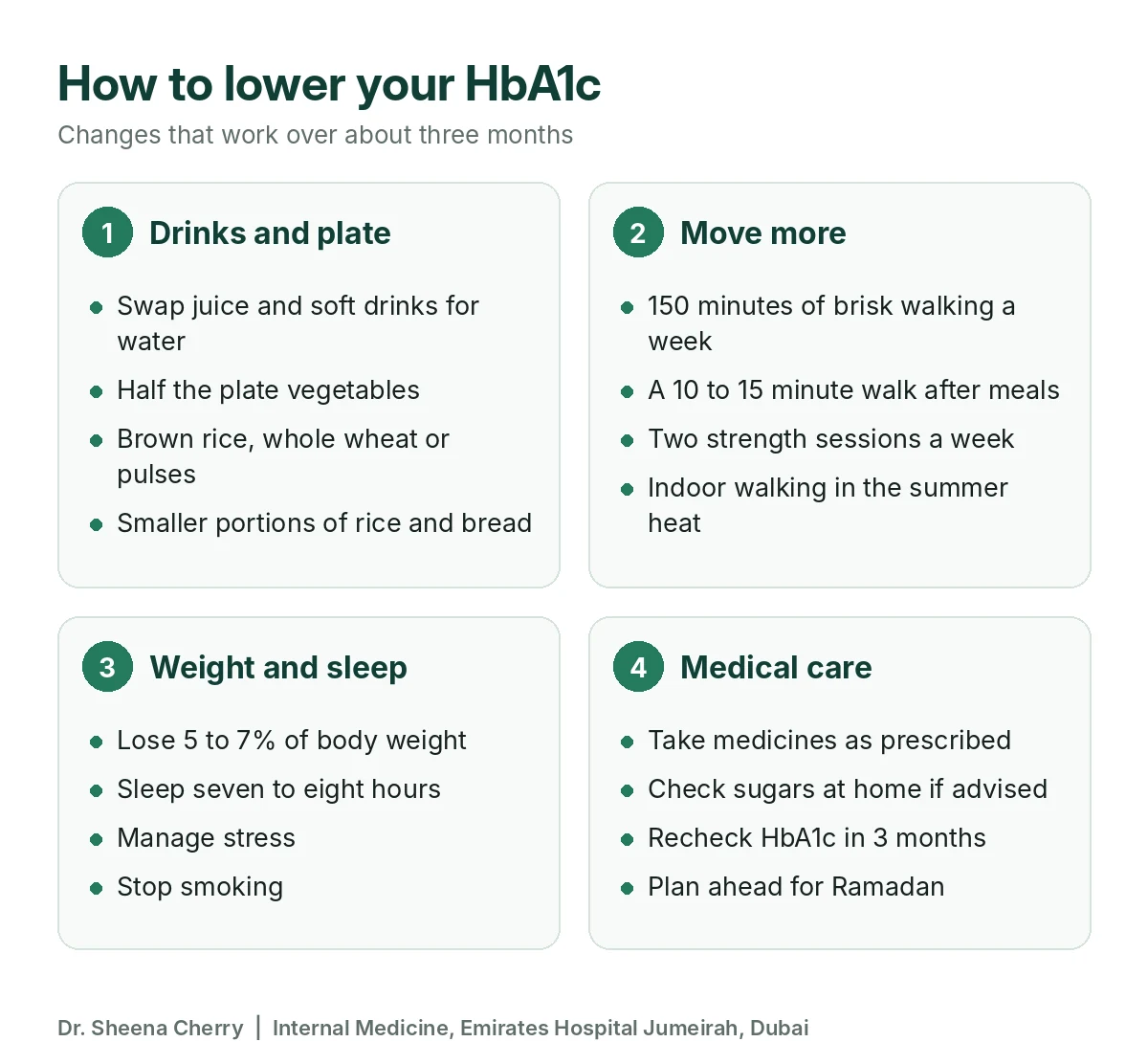
- Swap sugary drinks for water. Juice, soft drinks, sweetened tea and coffee drinks raise sugar quickly.
- Change the plate. Half vegetables, a quarter protein, a quarter carbohydrate. Choose brown rice, whole wheat or pulses over white rice and bread.
- Move after meals. A 10 to 15 minute walk after your main meal lowers the sugar spike.
- Lose a little weight. Even 5% makes a real difference.
- Take medicines as prescribed. Missed doses are a common reason for a high HbA1c.
- Sleep seven to eight hours. Short sleep raises blood sugar.
- Check at home if advised. Seeing your own readings helps you learn which foods affect you.
Because HbA1c reflects about three months, give changes at least eight to twelve weeks before judging the effect.
How to bring HbA1c down from 7.5%
An HbA1c of 7.5% (58 mmol/mol) is just above the usual target. For many people, steady changes in diet and activity, plus a review of medicines, can bring it below 7% within three to six months. If you are newly diagnosed, lifestyle changes alone sometimes achieve this. If you are already on treatment, your doctor may adjust the dose or add a medicine. Recheck after three months to see the effect.
How much can HbA1c fall?
Results vary, but as a rough guide, losing 5% to 10% of body weight often lowers HbA1c by around 0.5% to 1%, and many diabetes medicines lower it by 0.5% to 1.5% each. The higher the starting HbA1c, the bigger the fall tends to be.
When to see a doctor
- Your HbA1c is 5.7% or higher and you have not discussed it with a doctor
- Your HbA1c is 6.5% or higher
- You have diabetes and your HbA1c is above your target
- Your HbA1c does not match your home readings
- You are planning pregnancy and have prediabetes or diabetes
How Dr. Sheena Cherry can help
Dr. Sheena Cherry is a DHA-licensed Specialist in Internal Medicine at Emirates Hospital Jumeirah. She diagnoses and manages prediabetes and type 2 diabetes, checks for the conditions that often come with them, such as high blood pressure, high cholesterol and fatty liver, and agrees realistic targets and plans with each patient. Bring your latest HbA1c and any home readings to your appointment.
Frequently asked questions
What is a normal HbA1c level?
Below 5.7% (39 mmol/mol). A result of 5.7% to 6.4% is prediabetes, and 6.5% or above on two tests is diabetes.
What is normal HbA1c by age?
The normal range is the same for all adults: below 5.7%. Targets for people with diabetes are often less strict in older adults, such as below 7.5% or 8%, to avoid low sugars.
Is an HbA1c of 6.0 prediabetes?
Yes, under ADA criteria. 6.0% (42 mmol/mol) is in the prediabetes range. It is a good time to make changes, as prediabetes can often be reversed.
What HbA1c level is dangerous?
There is no single number, but an HbA1c above 9% to 10% means sugars have been high for months and needs prompt attention. Very high sugars with symptoms such as vomiting or drowsiness are an emergency.
What is the fastest way to reduce HbA1c?
Combining diet changes, regular activity, weight loss and, where needed, medicine works best. HbA1c usually starts to fall within weeks, but the full effect shows after about three months.
Is an HbA1c of 5.7 normal?
No. 5.7% (39 mmol/mol) is the lowest value of the prediabetes range under ADA criteria. It is a mild result and a good prompt to improve diet and activity and recheck in a year.
How can I reduce HbA1c from 7.5?
Cut sugary drinks, reduce portions of rice and bread, walk after meals, lose some weight and take medicines as prescribed. Many people reach below 7% within three to six months. Your doctor may also adjust treatment.
Do I need to fast for an HbA1c test?
No. HbA1c can be taken at any time of day, with or without food.
Can HbA1c be wrong?
Yes. Anaemia, recent blood loss or transfusion, pregnancy, kidney disease and some haemoglobin variants can make HbA1c read too high or too low. Your doctor may use other tests in these situations.
How often should HbA1c be checked?
Every three months if your diabetes treatment is changing or you are above target, every six months if stable at target, and once a year if you have prediabetes.
References
- American Diabetes Association. Standards of Care in Diabetes 2026. Diabetes Care 2026;49(Suppl 1)
- American Diabetes Association. Understanding A1C
- CDC. A1C test for diabetes and prediabetes
- NIDDK. Diabetes Prevention Program
- International Diabetes Federation. IDF Diabetes Atlas: United Arab Emirates country report
- Diabetes UK. What is HbA1c?
This guide is general information and does not replace a consultation. Read our medical disclaimer. For an emergency, call 998.
Specialist in Internal Medicine at Emirates Hospital Jumeirah, Dubai. MD in Internal Medicine, Fellowship in Critical Care Medicine and Postgraduate Certification in Cardiology from Johns Hopkins University. About Dr. Sheena