Ferritin Normal Range: Low, Normal and High Levels Explained
 Dr. Sheena Cherry, Specialist in Internal Medicine
17 min read
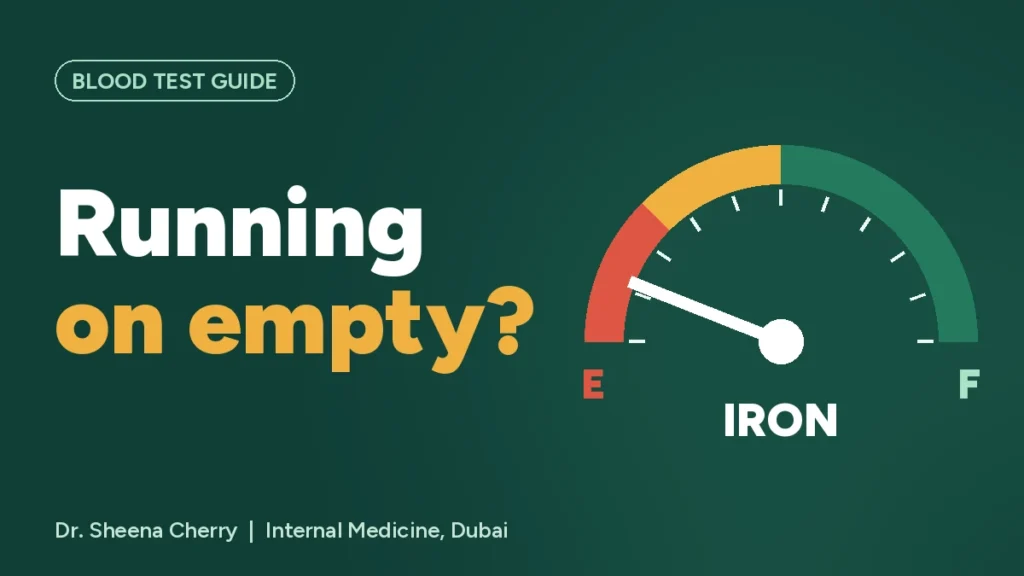
You open your blood test report and find one line flagged: ferritin. Maybe it says 18 ng/mL with an “L” next to it. Maybe it sits inside the printed range, yet you still feel drained by mid-afternoon, your hair is shedding more than usual and climbing the stairs leaves you out of breath. So what is a normal ferritin level, and does “normal” on the report mean you have enough iron?
The range printed on your report and the level that means you have enough iron are not always the same. New 2026 thresholds from the American Society of Hematology make the gap clearer, and most labs in the UAE have not added them to their reports yet.
Ferritin normal range: the short answer
- Typical lab ranges are about 15 to 200 ng/mL for women and 30 to 500 ng/mL for men. Each lab sets its own range, so always read the one printed on your report.
- Ferritin of 15 ng/mL or lower confirms low iron stores (World Health Organization).
- Since 2026, the American Society of Hematology suggests that a ferritin of 30 ng/mL or lower already points to iron deficiency in most adults, even if the lab marks it as normal.
- High ferritin is more often caused by inflammation, fatty liver, alcohol or infection than by too much iron.
- Ferritin is read together with your haemoglobin, transferrin saturation and CRP, never on its own.
In this guide: What ferritin is · Ferritin normal range by group · Lab range vs enough iron · Low ferritin · High ferritin · The full iron panel · How to raise low ferritin · When to see a doctor · FAQs
What is ferritin?
Ferritin is a protein that stores iron inside your cells, mostly in the liver, spleen and bone marrow. A small amount of it leaks into the blood, and the ferritin blood test measures that amount. Because the level in the blood rises and falls with the iron held in storage, ferritin is the best single test for checking your iron reserves.
Think of haemoglobin as the money in your wallet, and ferritin as your savings account. When you lose iron, through periods, pregnancy, a poor diet or slow bleeding from the gut, your body spends the savings first. Ferritin falls for months before haemoglobin drops. So a person can have a normal blood count but low ferritin, and still feel unwell.
Ferritin is also an “acute phase” protein. It rises during infection, inflammation and liver stress, whatever your iron stores are. So a normal or high result does not always mean you have plenty of iron.
Ferritin normal range by age and sex
Labs report ferritin in ng/mL or µg/L. The two units are the same number, so 30 ng/mL equals 30 µg/L. The ranges below are typical values used by large hospitals. Your own lab may print slightly different numbers.
| Group | Typical lab range | Points to low iron stores |
|---|---|---|
| Adult women | 15 to 205 ng/mL | 30 or lower (ASH 2026) |
| Adult men | 30 to 566 ng/mL | 30 or lower (ASH 2026) |
| Pregnancy | Varies by lab and trimester | 30 or lower; up to 50 may be used if anaemic (ASH 2026) |
| Children 6 months to 15 years | 12 to 140 ng/mL | 20 or lower for ages 9 months to 4 years (ASH 2026) |
| Adults with inflammation | May look normal or high | Below 100, or transferrin saturation below 20% (ASH 2026) |
Lab ranges: Cleveland Clinic. Low iron thresholds: American Society of Hematology 2026 guidelines. A doctor reads your result with your symptoms and other tests.
Ferritin normal range in the UAE
Labs in Dubai and across the UAE report ferritin in ng/mL or µg/L and print a reference range much like the ones above. Ranges still differ a little between hospital labs and home-testing services because each uses its own equipment and reference population. If you compare results from two labs, look at where each result sits in its own ferritin normal range rather than at the raw numbers. Most UAE labs have not yet changed their printed ranges to reflect the 2026 ASH thresholds, so a result of 20 ng/mL may still appear without a flag.
Why a “normal” ferritin can still mean low iron
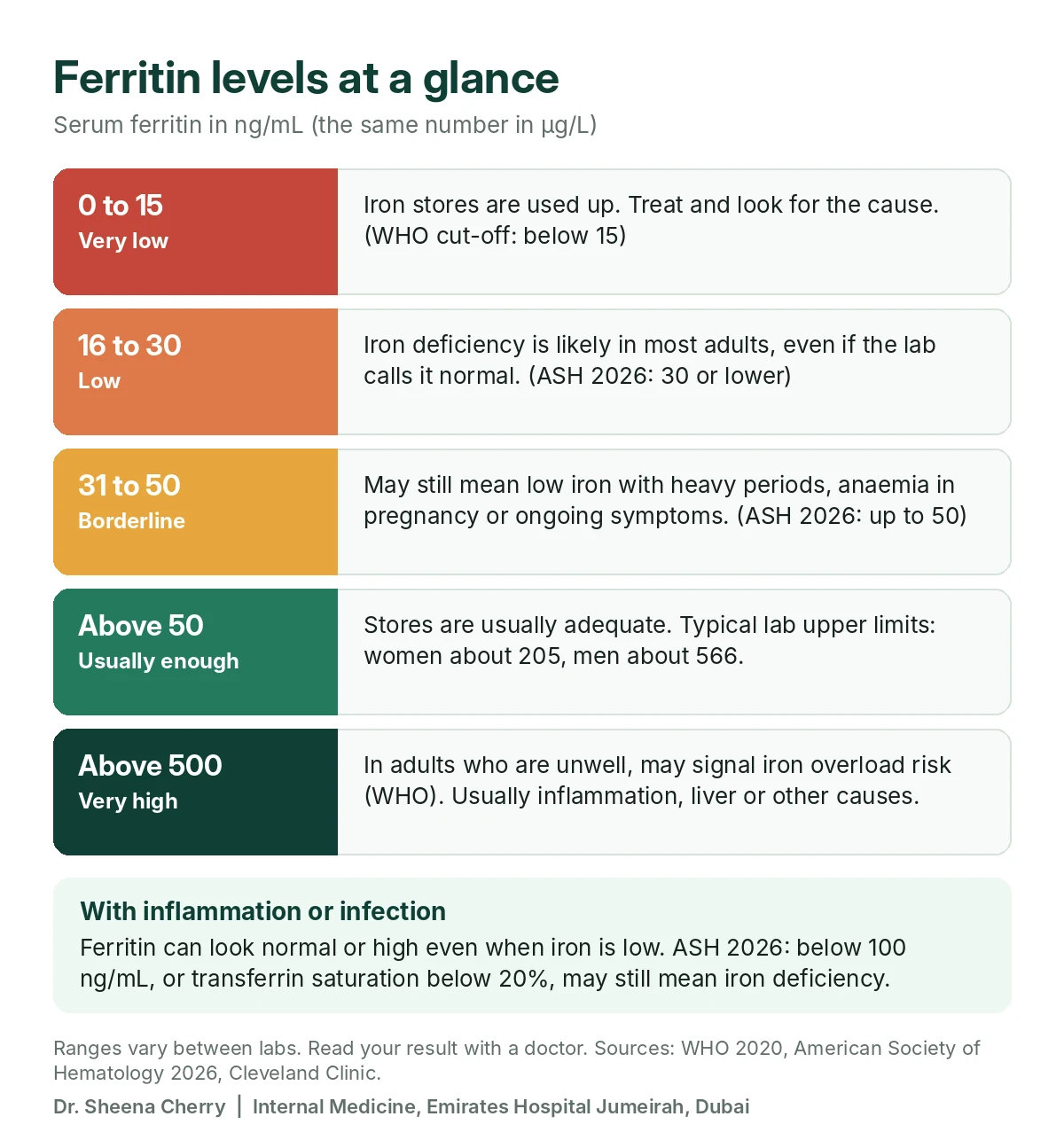
The lower limit printed on many reports, often 13 to 15 ng/mL for women, was chosen to be very specific. If your ferritin is below it, you almost certainly have low iron. The problem is the other direction: plenty of people with a ferritin of 20 or 25 ng/mL are also short of iron, but the report calls them normal.
The World Health Organization uses below 15 ng/mL as the cut-off for low iron stores in healthy adults. In 2026 the American Society of Hematology (ASH) published its first guideline on diagnosing iron deficiency and set the threshold higher, at 30 ng/mL or lower for most adults, including women who menstruate and pregnant women. For people with symptoms or ongoing risk, such as heavy periods or anaemia in pregnancy, a threshold of 50 ng/mL or lower may be used. These thresholds apply whether or not anaemia is present.
If your ferritin is between 15 and 30 ng/mL and you feel tired, short of breath or are losing hair, ask a doctor to look at the whole picture, even if the report says normal.
Low ferritin: what it means
Low ferritin means your iron stores are running down. Iron deficiency develops in three stages, and ferritin is the first test to change:
- Depleted stores. Ferritin falls. Haemoglobin and red cells are still normal. You may already feel tired.
- Iron-deficient red cell production. Transferrin saturation drops and new red cells start to come out smaller (low MCV).
- Iron deficiency anaemia. Haemoglobin falls below normal. Symptoms usually become clearer.
Symptoms of low ferritin
Some people have no symptoms at all. Others notice:
- Tiredness and low energy that sleep does not fix
- Shortness of breath or a pounding heartbeat on exertion
- Pale skin or pale inner eyelids
- Hair shedding and brittle or spoon-shaped nails
- Headaches, poor concentration and low mood
- Restless legs in the evening
- Cravings for ice, clay or other non-food items (pica)
- Sore tongue or cracks at the corners of the mouth
For a fuller list, see our guide to iron deficiency symptoms and tests.
Common causes of low ferritin
- Heavy or long periods. The most common cause in women of child-bearing age.
- Pregnancy and breastfeeding. The baby’s needs draw heavily on your stores.
- Diet. Little red meat, a vegetarian diet without careful planning, or strong tea and coffee with meals, which block iron absorption.
- Blood loss from the gut. Stomach ulcers, regular use of painkillers such as ibuprofen or aspirin, polyps, piles and, less often, bowel cancer. In men and in women after menopause, low ferritin always needs this checked.
- Poor absorption. Coeliac disease, H. pylori infection, stomach surgery or long-term acid-reducing medicines.
- Frequent blood donation or endurance sport.
Finding the cause matters as much as replacing the iron. If you are a man, or a woman past menopause, and your ferritin is low, a doctor will usually look for hidden blood loss from the gut. Our page on digestive health explains what this can involve.
High ferritin: causes and when to worry
A ferritin above your lab’s range is common and, in most cases, it is not caused by too much iron. Because ferritin rises with stress on the body, the usual causes are:
- Infection, including a recent cold, flu or COVID-19
- Inflammation from conditions such as rheumatoid arthritis or inflammatory bowel disease
- Fatty liver disease, which is closely linked to weight, diabetes and high cholesterol
- Regular alcohol use
- Chronic kidney disease and heart failure
- An overactive thyroid
- Some cancers
- Iron overload, from repeated blood transfusions, too many iron supplements or genetic haemochromatosis
The WHO notes that in adults who are unwell, a ferritin above 500 µg/L may indicate a risk of iron overload. A doctor will usually check transferrin saturation, liver tests and CRP to tell inflammation apart from true iron overload. If both ferritin and transferrin saturation are high, further tests, including genetic testing for haemochromatosis, may follow.
High ferritin with abnormal liver tests often points to fatty liver. Weight loss, more activity, cutting alcohol and controlling blood sugar can bring both down over a few months.
Ferritin and the other iron tests
Ferritin is one part of an “iron panel” or “iron studies”. Looking at the tests together gives a much clearer answer than any single number.
| Test | What it shows | In iron deficiency |
|---|---|---|
| Ferritin | Iron stores | Low (but can look normal with inflammation) |
| Serum iron | Iron in the blood at that moment; changes through the day and after meals | Often low |
| Transferrin or TIBC | How much iron the blood can carry | High |
| Transferrin saturation (TSAT) | How full the carrier protein is | Low, often below 20% |
| Haemoglobin (Hb) | Oxygen-carrying red cell protein | Low in iron deficiency anaemia |
| MCV | Average red cell size | Low (small cells) |
| CRP | Inflammation | If high, ferritin may be falsely reassuring |
If you only had ferritin checked, and the result does not fit how you feel, ask whether a full blood count, transferrin saturation and CRP are needed.
Reading your result against the ferritin normal range: four examples
These examples show how a doctor reads ferritin alongside other results. Your own results need a doctor’s review.
Example 1: ferritin 9 ng/mL, haemoglobin low, MCV low
This is a classic pattern of iron deficiency anaemia. Iron stores are empty and red cells are small. Treatment usually starts straight away, and the doctor looks for the cause, such as heavy periods or blood loss from the gut.
Example 2: ferritin 24 ng/mL, haemoglobin normal, feeling exhausted
The report may call this normal, yet it is below the 30 ng/mL threshold suggested by ASH. This is iron deficiency without anaemia. If symptoms fit and there are risk factors such as heavy periods, a trial of iron and a recheck after a few months is a reasonable plan.
Example 3: ferritin 180 ng/mL, CRP high, recovering from flu
Ferritin is raised because of the infection, not because of extra iron. Repeating the test a few weeks after recovery gives a truer picture. If transferrin saturation is low at the same time, iron deficiency may still be hiding underneath.
Example 4: ferritin 650 ng/mL, transferrin saturation high, liver tests abnormal
This needs further assessment for iron overload and liver disease. The doctor may arrange repeat iron studies, a liver scan and genetic testing for haemochromatosis. Iron supplements should be stopped.
Ferritin myths and facts
- “My ferritin is in the normal range, so my iron is fine.” Not always. A ferritin between 15 and 30 ng/mL can still mean low iron, and inflammation can hide a deficiency.
- “High ferritin means I eat too much iron.” Rarely. Inflammation, fatty liver, alcohol and infection are far more common causes.
- “Spinach alone will fix low iron.” Spinach helps, but plant iron is poorly absorbed. Once stores are empty, most people need a supplement as well as diet changes.
- “More iron is always better.” No. Taking iron you do not need can cause stomach upset and, over time, iron overload.
Ferritin in women, pregnancy, children and older adults
Women
Women who menstruate lose iron every month, so their stores are often lower. Under the 2026 ASH guideline, a ferritin of 30 ng/mL or lower suggests iron deficiency, and 50 ng/mL or lower may be used if periods are heavy. Heavy periods are worth treating in their own right, so mention them to your doctor.
Pregnancy
Iron needs rise sharply in pregnancy, especially in the second and third trimesters. Ferritin is often checked early in pregnancy. Low iron is usually treated promptly, often with tablets and sometimes with an iron infusion, so that you start labour with healthy reserves.
Children
For children aged 9 months to 4 years, ASH suggests a ferritin of 20 ng/mL or lower indicates iron deficiency. Toddlers who drink a lot of cow’s milk are at higher risk. Iron supplements must be kept out of children’s reach, as an overdose can be dangerous.
Men and older adults
Men and women after menopause do not lose iron monthly, so low ferritin in these groups is a signal to look for a cause, most often slow bleeding from the stomach or bowel. In older adults, high ferritin is more often due to inflammation, kidney disease or liver problems.
Does low ferritin cause hair loss?
Many people first test their ferritin because of hair shedding. Low iron is one of several possible causes of diffuse hair loss, along with thyroid problems, stress, recent illness and hormonal changes. The evidence linking ferritin levels to hair loss is mixed, and there is no single “hair target” that suits everyone. If you are losing hair and your ferritin is low or borderline, correcting the iron is reasonable, and it makes sense to check thyroid function and vitamin D at the same time.
How to raise low ferritin
1. Treat the cause
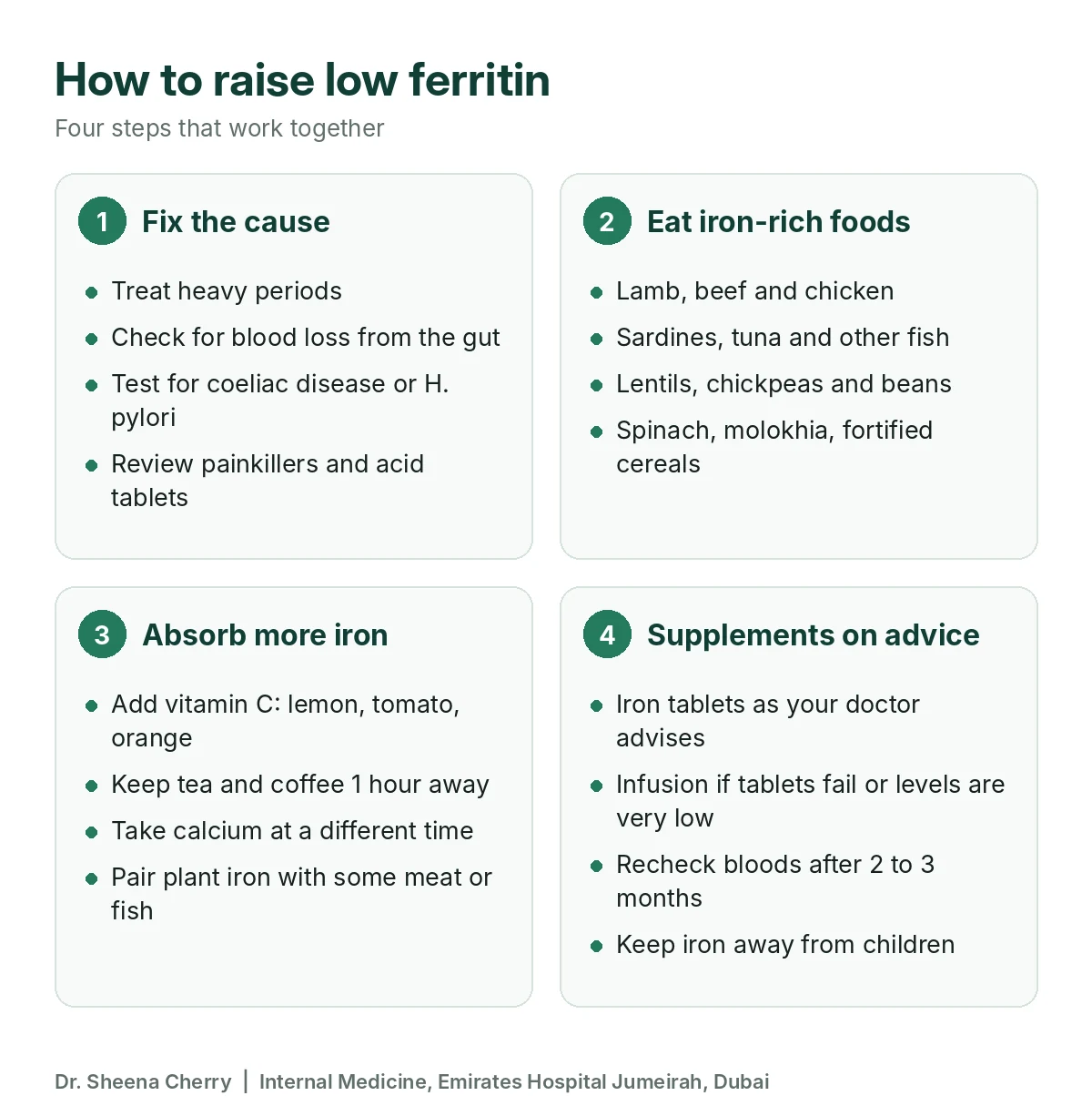
Iron replacement works best when the reason for the loss is fixed: heavy periods treated, a stomach ulcer healed, coeliac disease managed or painkillers reviewed.
2. Eat more iron, and absorb it better
Iron from meat, chicken and fish (haem iron) is absorbed far more easily than iron from plants. Plant iron still counts, especially when eaten with vitamin C.
| Good sources | Examples common in the UAE |
|---|---|
| Red meat | Lamb, beef, mutton |
| Poultry and fish | Chicken thighs, sardines, tuna, hammour |
| Pulses | Lentils (dal, adas soup), chickpeas (hummus), beans |
| Greens and seeds | Spinach, molokhia, pumpkin seeds, sesame (tahini) |
| Fortified foods | Iron-fortified breakfast cereals and breads |
- Add vitamin C to iron-rich meals: lemon juice, tomatoes, peppers, oranges or guava.
- Keep tea and coffee at least an hour away from meals and iron tablets.
- Take calcium supplements and dairy at a different time from iron tablets.
Diet alone is usually enough to maintain stores, but it is slow to refill them once they are empty. Most people with clear iron deficiency need a supplement.
3. Iron tablets
Your doctor will advise the type and dose. A few practical points:
- Take iron on an empty stomach if you can, or with a small meal if it upsets your stomach.
- Some studies suggest that taking iron every other day is absorbed as well as daily dosing, with fewer side effects. Ask your doctor whether this suits you.
- Dark stools, constipation and mild nausea are common side effects.
- Keep taking iron for a few months after your blood count is normal to refill the stores. Your doctor will recheck your levels.
4. Iron infusion
An iron infusion through a drip may be recommended if tablets do not work or cannot be tolerated, if the deficiency is severe, in later pregnancy or when absorption is poor. It refills stores within weeks rather than months. Learn more on our iron deficiency and anaemia page.
How long does it take to raise ferritin?
With tablets, most people feel better within a few weeks, and haemoglobin usually starts to rise within the first month. Ferritin takes longer, often several months, because stores are refilled last. A repeat blood test is usually done after about two to three months of treatment.
Getting a ferritin test in Dubai
- Fasting: not needed for ferritin alone. If serum iron is included, your doctor may ask for a morning sample.
- Timing: avoid testing during or just after a cold or other infection, as ferritin can be falsely raised.
- Supplements: tell your doctor if you are already taking iron or multivitamins.
- What to ask for: a full blood count, ferritin, transferrin saturation and CRP give the clearest picture.
- Insurance: most plans cover iron tests when a doctor requests them for symptoms. Check your plan or call 800 444 444.
When to see a doctor
Book an appointment if:
- Your ferritin is below your lab’s range, or below 30 ng/mL and you have symptoms
- Your ferritin is above the range and you do not know why
- You are a man, or past menopause, and have low ferritin
- You have taken iron for three months and your levels have not improved
- You are pregnant or planning pregnancy and have low iron
How Dr. Sheena Cherry can help
Dr. Sheena Cherry is a DHA-licensed Specialist in Internal Medicine at Emirates Hospital Jumeirah, Dubai. In a consultation she reviews your full report, including the results that are not flagged, asks about periods, diet, medicines and digestive symptoms, and decides with you whether you need more tests, treatment or just a recheck. If you have a recent ferritin result you are unsure about, bring it with you.
Frequently asked questions
What is a normal ferritin level?
Most labs use about 15 to 200 ng/mL for women and 30 to 500 ng/mL for men, but ranges vary. Under the 2026 ASH guideline, a ferritin of 30 ng/mL or lower suggests iron deficiency in most adults, even if the lab marks it as normal.
Is a ferritin of 28 low?
A ferritin of 28 ng/mL is inside many lab ranges, but it is at or below the 30 ng/mL threshold that ASH now suggests for iron deficiency. If you have symptoms or risk factors such as heavy periods, it is worth discussing treatment with a doctor.
Is a ferritin of 7 anaemic?
A ferritin of 7 ng/mL means your iron stores are very low. Whether you are anaemic depends on your haemoglobin, which is checked on a full blood count. Either way, a ferritin this low needs treatment and a search for the cause.
What ferritin level is dangerous?
Very low ferritin, often below 10 ng/mL, usually comes with anaemia and needs prompt treatment. At the high end, the WHO notes that a ferritin above 500 µg/L in adults who are unwell may indicate a risk of iron overload, and much higher values need urgent assessment.
Is ferritin the same as iron?
No. Serum iron measures iron in the blood at one moment and changes through the day. Ferritin reflects the iron stored in your body, so it is a better guide to your overall iron status.
Do I need to fast for a ferritin test?
Not for ferritin alone. If serum iron or other tests are done at the same time, your doctor may ask for a morning sample.
Which foods increase ferritin?
Red meat, chicken, fish, lentils, chickpeas, beans, spinach and fortified cereals. Eating them with vitamin C and keeping tea and coffee away from meals helps your body absorb more iron.
Can stress or exercise raise ferritin?
Infection and inflammation raise ferritin. Very hard exercise can cause a short-term rise, and endurance athletes can also lose iron over time. If your result does not fit your symptoms, a repeat test when you are well may help.
References
- World Health Organization. Guideline on use of ferritin concentrations to assess iron status in individuals and populations, 2020
- WHO eLENA. Use of ferritin concentrations to assess iron status
- Powers J, et al. American Society of Hematology 2026 guidelines for diagnosis of iron deficiency. Blood Advances, 2026
- Cleveland Clinic. Ferritin test
- MedlinePlus. Ferritin blood test
- NHS. Iron deficiency anaemia
This guide is general information and does not replace a consultation. Read our medical disclaimer. For an emergency, call 998.
Specialist in Internal Medicine at Emirates Hospital Jumeirah, Dubai. MD in Internal Medicine, Fellowship in Critical Care Medicine and Postgraduate Certification in Cardiology from Johns Hopkins University. About Dr. Sheena