CBC Test Explained: What Each Number Means
 Dr. Sheena Cherry, Specialist in Internal Medicine
15 min read
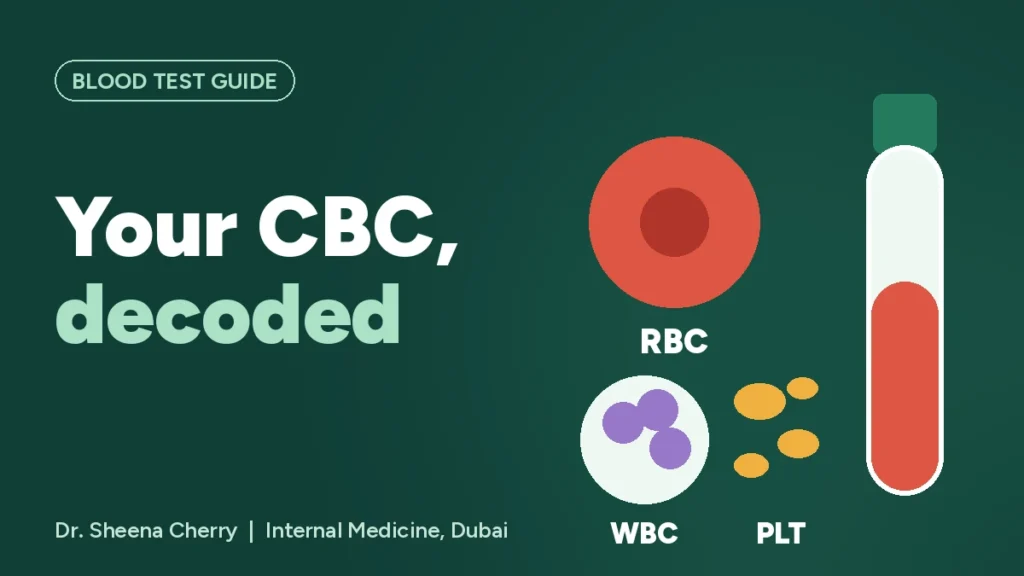
A complete blood count is the most common blood test in the world, and also one of the most confusing to read. The report is a long list of abbreviations, numbers and units, with a few results flagged H or L. Some flags matter a lot and many mean very little, so it helps to know which is which before you start worrying, or before you put off an appointment you need.
A CBC report has about 15 results. Each one measures something about your red cells, white cells or platelets, and doctors read them in groups rather than one at a time. If you live in the UAE, a few local points also matter: the units your lab uses, thalassaemia trait, and the naturally lower neutrophil counts seen in some families.
CBC test explained: the short answer
- A CBC (complete blood count, also called a full blood count or FBC) measures your red cells, white cells and platelets.
- It helps find anaemia, infection, inflammation, bleeding risk and some blood disorders.
- Typical adult ranges: haemoglobin 11.5 to 15.5 g/dL in women and 13 to 17 g/dL in men, white cells 4.0 to 10.0 x10⁹/L, platelets 150 to 400 x10⁹/L.
- One result slightly outside the range is common and often not a concern. Patterns across several results matter more.
- You do not need to fast for a CBC alone.
In this guide: What a CBC is · Normal values · Red cell results · White cell results · Platelets · Common patterns · CBC results in the UAE · When to see a doctor · FAQs
What is a CBC test?
A complete blood count is a single blood sample, usually taken from a vein in your arm, that a machine analyses for three types of cells:
- Red blood cells carry oxygen from your lungs to every part of your body, using a protein called haemoglobin.
- White blood cells fight infection and are part of your immune system.
- Platelets are small cell fragments that help your blood clot.
Doctors order a CBC as part of a routine check-up, to investigate symptoms such as tiredness, fever, bruising or weight loss, before surgery, and to monitor conditions or medicines that affect the blood. It is often requested with other tests, such as ferritin, kidney and liver function, HbA1c or thyroid tests.
CBC vs CBC with differential
A basic CBC gives one total white cell count. A CBC with differential splits that total into the five types of white cell: neutrophils, lymphocytes, monocytes, eosinophils and basophils. Most labs in Dubai report the differential automatically, so you will usually see all five on your report.
CBC normal values for adults
Each lab sets its own reference ranges, so always compare your result with the range printed next to it. The values below are typical adult ranges used by large hospitals.
| Test | What it measures | Typical adult range |
|---|---|---|
| Haemoglobin (Hb) | Oxygen-carrying protein | Women 11.5 to 15.5 g/dL; men 13 to 17 g/dL |
| Red blood cells (RBC) | Number of red cells | Women 4.0 to 5.4; men 4.5 to 6.1 million/µL |
| Haematocrit (Hct or PCV) | Share of blood made of red cells | Women 36 to 48%; men 40 to 55% |
| MCV | Average red cell size | 80 to 100 fL |
| MCH | Haemoglobin per red cell | 27 to 31 pg |
| MCHC | Haemoglobin concentration in red cells | 32 to 36 g/dL |
| RDW | Variation in red cell size | 12 to 15% |
| White blood cells (WBC) | Total infection-fighting cells | 4.0 to 10.0 x10⁹/L |
| Neutrophils | Fight bacteria | 2.5 to 7.0 x10⁹/L |
| Lymphocytes | Fight viruses, make antibodies | 1.0 to 4.8 x10⁹/L |
| Monocytes | Clear debris, fight infection | 0.2 to 0.8 x10⁹/L |
| Eosinophils | Allergy and parasites | Below 0.5 x10⁹/L |
| Basophils | Allergic reactions | Below 0.3 x10⁹/L |
| Platelets (PLT) | Clotting | 150 to 400 x10⁹/L |
| MPV | Average platelet size | 7.0 to 9.0 fL |
Ranges: Cleveland Clinic. x10⁹/L is the same number as thousands per µL (k/µL). Children, pregnant women and people living at altitude have different ranges.
Red cell results: haemoglobin, MCV and the rest
Haemoglobin (Hb)
Haemoglobin is the number most people look at first. Low haemoglobin means anaemia. The World Health Organization defines anaemia in adults as haemoglobin below 12 g/dL in non-pregnant women, below 13 g/dL in men and, in pregnancy, below 11 g/dL in the first and third trimesters and below 10.5 g/dL in the second.
- Low: iron deficiency, blood loss, vitamin B12 or folate deficiency, chronic kidney disease, long-term inflammation, thalassaemia trait and, less often, bone marrow problems.
- High: dehydration, smoking, living at altitude, sleep apnoea, testosterone treatment, lung or heart disease and, rarely, a bone marrow condition called polycythaemia vera.
Red blood cell count (RBC) and haematocrit
These usually move with haemoglobin. A high red cell count with a low MCV and near-normal haemoglobin is a typical clue to thalassaemia trait, which we cover below.
MCV: the size of your red cells
MCV is one of the most useful numbers on the report because it helps narrow down the cause of anaemia.
- Low MCV (small cells, microcytosis): iron deficiency and thalassaemia trait are the two main causes.
- Normal MCV: recent bleeding, kidney disease, inflammation or a mix of causes.
- High MCV (large cells, macrocytosis): vitamin B12 or folate deficiency, regular alcohol use, an underactive thyroid, liver disease and some medicines, including metformin over the long term (through low B12).
MCH, MCHC and RDW
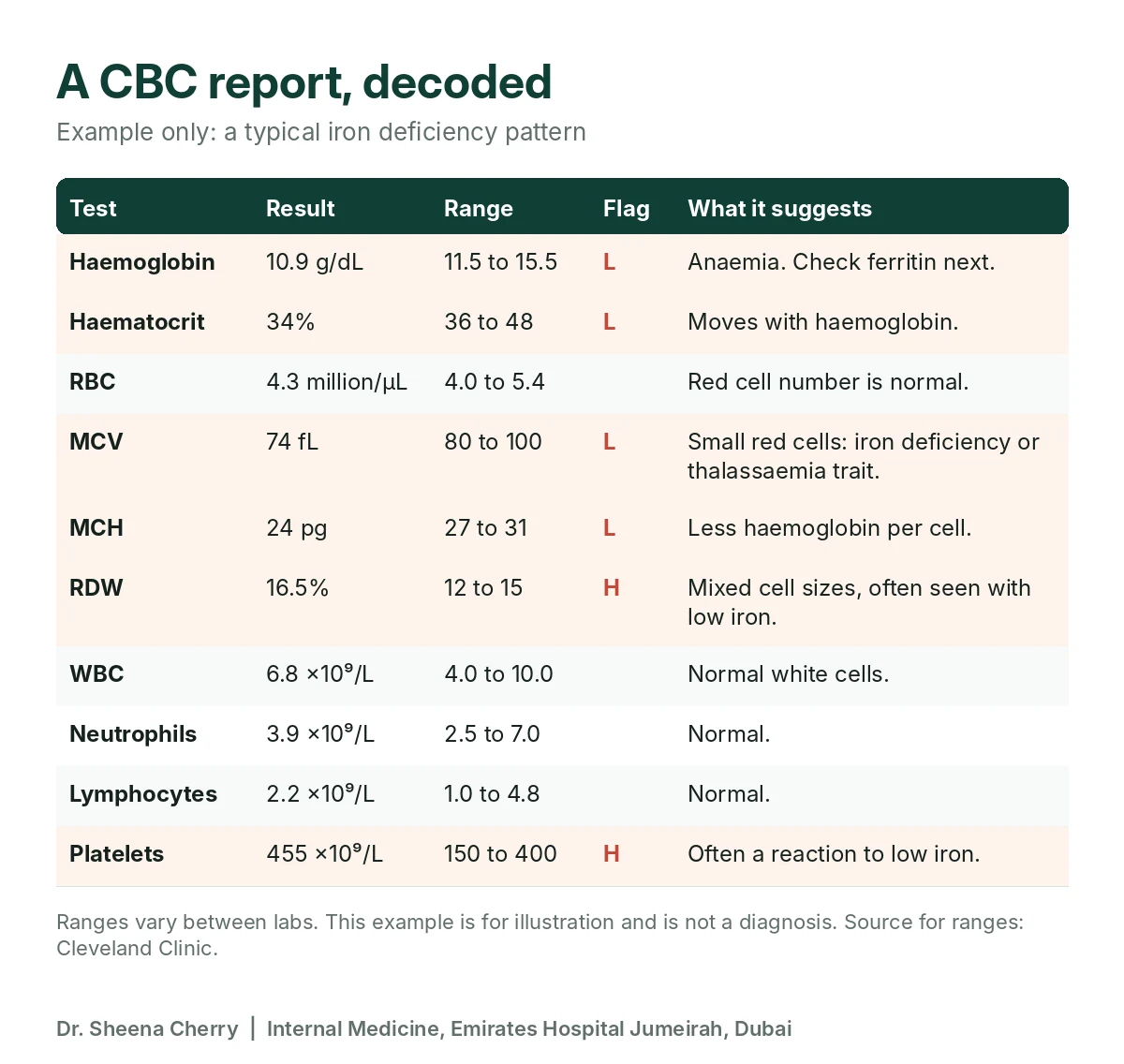
MCH and MCHC tell you how much haemoglobin each red cell holds. They are usually low when MCV is low. RDW shows how varied the cells are in size. A high RDW with a low MCV leans towards iron deficiency, while a normal RDW with a very low MCV leans towards thalassaemia trait. These are clues, and a ferritin test settles most cases.
White cell results: what high and low counts mean
Total white cell count (WBC)
- High (leucocytosis): most often infection, inflammation, steroid tablets, smoking, stress or recent intense exercise. Very high counts, or abnormal cells on the film, need prompt review.
- Low (leucopenia): viral infections, some medicines, autoimmune conditions, low B12 or folate and, less commonly, bone marrow problems. A mildly low count can also be normal for you.
The five white cell types
| Cell | Often high with | Often low with |
|---|---|---|
| Neutrophils | Bacterial infection, inflammation, steroids, smoking, stress | Viral infection, some medicines, autoimmune disease; can be normal in some ethnic groups |
| Lymphocytes | Viral infections such as glandular fever, recovery from illness | Acute stress, steroids, some infections including HIV |
| Monocytes | Recovery from infection, chronic inflammation | Rarely important on its own |
| Eosinophils | Allergies, asthma, eczema, parasites, some medicines | Steroids; usually not important |
| Basophils | Allergic reactions; rarely, a blood disorder | Usually not important |
Low neutrophils that are normal for you
Some healthy people, particularly those of African or Middle Eastern family background, naturally have neutrophil counts below the standard lab range. This is now often called Duffy-null associated neutrophil count, and it does not increase the risk of infection. If your neutrophils have always been slightly low, you feel well and the rest of your blood count is normal, this may be the reason. A doctor can confirm it by looking at your earlier results.
Platelet results
- Low platelets (thrombocytopenia): viral infections, including dengue, some medicines, heavy alcohol use, liver disease, an enlarged spleen, pregnancy and immune conditions. A falsely low result can also happen when platelets clump in the sample tube, and a repeat sample in a different tube often clears it up.
- High platelets (thrombocytosis): most often a reaction to iron deficiency, infection, inflammation or recent surgery. Persistently high counts without a clear cause need a doctor’s review.
Reading your CBC: common patterns
Doctors rarely read one number in isolation. These are the patterns that come up most often in clinic. Your own results need a doctor’s review.
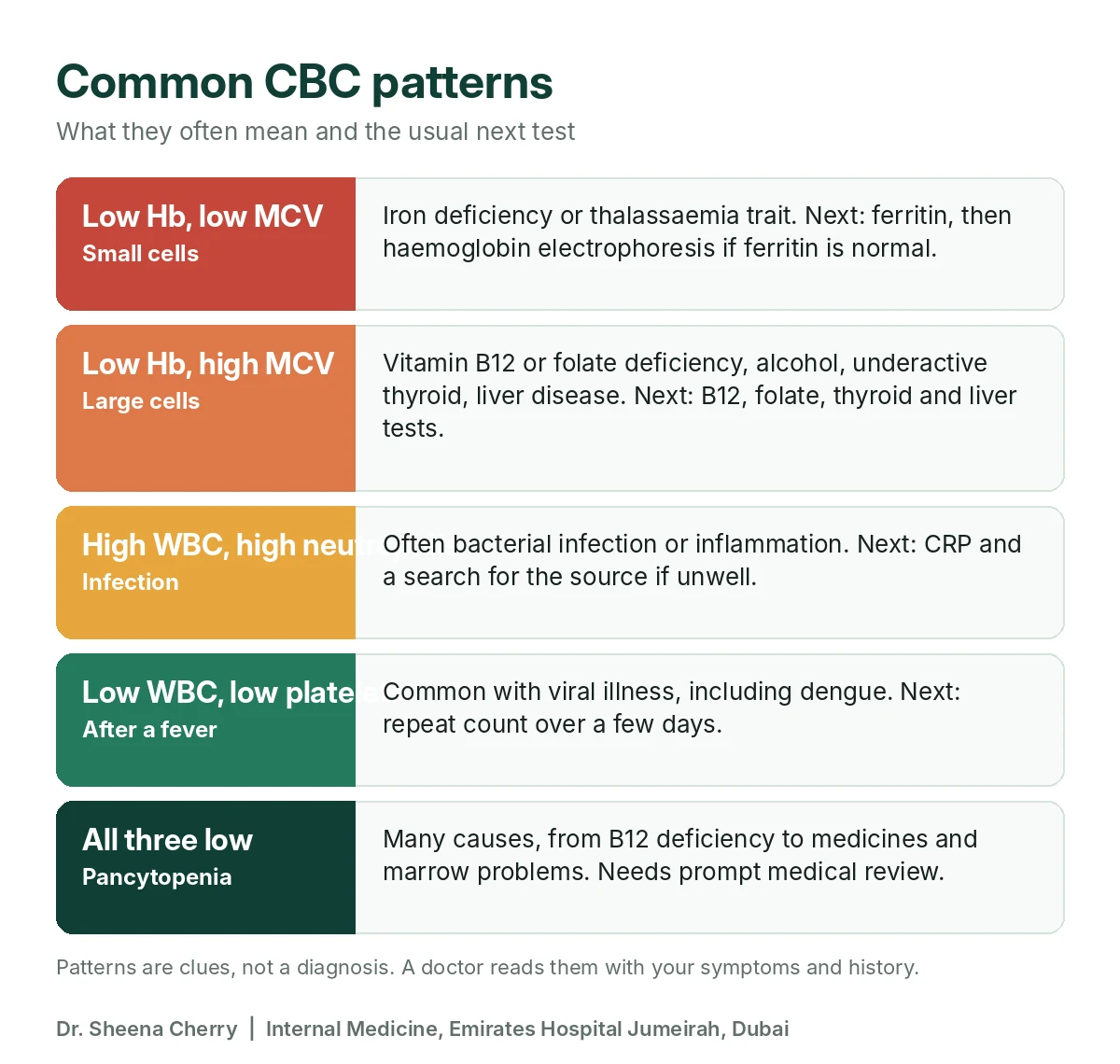
Low haemoglobin with small cells (low MCV)
Usually iron deficiency or thalassaemia trait. The next step is a ferritin test. See our guide to the ferritin normal range and our page on iron deficiency and anaemia.
Low haemoglobin with large cells (high MCV)
Think of vitamin B12 or folate deficiency, alcohol, an underactive thyroid or liver disease. B12, folate, thyroid and liver tests are usually next.
High white cells with high neutrophils
Often a bacterial infection or inflammation, especially with fever. CRP and a search for the source follow if you are unwell. Our page on fever and infections explains how this is assessed.
Low white cells and low platelets after a fever
Common with viral illnesses, including dengue. Your doctor may repeat the count over a few days to make sure it recovers.
High red cells, low MCV, near-normal haemoglobin, normal ferritin
A typical picture of thalassaemia trait, which is discussed below. Iron tablets will not help this.
Several results low at the same time
When red cells, white cells and platelets are all low, doctors call it pancytopenia. It has many causes, from vitamin B12 deficiency to medicines and bone marrow conditions, and it should always be reviewed promptly.
How to read your CBC report in five steps
A simple order for reading your own report:
- Check the units and ranges. Confirm whether haemoglobin is in g/dL or g/L and note the range printed next to each result.
- Start with haemoglobin. If it is normal, you do not have anaemia, even if a red cell index such as MCH is slightly off.
- If haemoglobin is low, look at MCV. Small cells point towards iron deficiency or thalassaemia trait; large cells towards B12, folate, alcohol or thyroid causes.
- Look at the white cells as a group. Note whether the total is high or low and which type is driving it. Neutrophils lead in bacterial infection, lymphocytes in viral infection, eosinophils in allergy.
- Finish with platelets. Mildly high platelets often reflect low iron or recent infection. Low platelets after a fever often recover within days, but should be rechecked.
Then compare with your previous reports if you have them. A result that has been the same for five years means something very different from one that changed last month.
CBC results in the UAE: what to know
Units on UAE lab reports
Labs in Dubai and across the UAE mostly report haemoglobin in g/dL, but some use g/L. The numbers look very different, so check the unit before you worry.
| Test | Unit A | Unit B | Conversion |
|---|---|---|---|
| Haemoglobin | g/dL (e.g. 13.5) | g/L (e.g. 135) | Multiply g/dL by 10 |
| White cells and platelets | x10⁹/L (e.g. 7.2) | cells/µL (e.g. 7,200) | Multiply by 1,000 |
| Haematocrit | % (e.g. 42) | L/L (e.g. 0.42) | Divide % by 100 |
Thalassaemia trait
Thalassaemia trait is common in the Gulf region and in families from South Asia and the Mediterranean. It usually causes small red cells and a slightly low or normal haemoglobin, with a normal ferritin. People with the trait are generally well and do not need treatment, but it matters for family planning, and it is often mistaken for iron deficiency. The UAE premarital screening programme includes tests for inherited blood disorders such as thalassaemia. If your MCV is always low but your iron is normal, ask your doctor about haemoglobin electrophoresis, a test that confirms the trait.
Low iron and vitamin B12 in the UAE
Iron deficiency is common among women in the UAE, and long-term use of metformin or acid-reducing tablets can lower B12. These are two of the most frequent reasons for an abnormal MCV in clinic.
What can affect your CBC results
Several everyday things can move your results without any disease being present:
- Recent illness: a cold, flu or stomach bug can change white cell and platelet counts for a week or two.
- Periods and pregnancy: heavy periods lower haemoglobin and iron. In pregnancy, haemoglobin falls naturally as blood volume rises.
- Medicines: steroids raise white cells; some antibiotics, anti-seizure drugs, chemotherapy and thyroid medicines can lower them; aspirin and anti-inflammatories can cause slow bleeding from the stomach.
- Smoking: raises haemoglobin and white cells.
- Dehydration: concentrates the blood, so haemoglobin and haematocrit look higher.
- Hard exercise: can raise white cells for a few hours, and endurance training can lower iron over time.
- Sample handling: platelet clumping or a delay in testing can give a falsely abnormal result.
If your result does not fit how you feel, a repeat test after a few weeks is often the simplest next step.
CBC in children and in pregnancy
Children have different normal values that change with age. Newborns have high haemoglobin, toddlers have more lymphocytes than adults, and teenagers move towards adult ranges. Always use the age-specific range on a child’s report.
In pregnancy, a CBC is checked at booking and again later on. Haemoglobin naturally drops a little because blood volume increases, white cells often rise slightly and platelets can fall a little towards the end of pregnancy. Your obstetrician will compare results with pregnancy-specific ranges.
How to prepare for a CBC test
- Fasting: not needed for a CBC alone. If glucose or cholesterol tests are taken from the same sample, you may be asked to fast.
- Medicines: keep taking your usual medicines unless your doctor says otherwise, and mention steroids, blood thinners and supplements.
- Timing: results from a sample taken during a cold or flu may show changes that settle when you recover.
- Hydration: drink water as normal. Dehydration can raise haemoglobin and haematocrit slightly.
- Results: most labs report a CBC within a few hours to one day.
Is one abnormal result something to worry about?
Usually not. Reference ranges are built so that about 5% of healthy people fall outside them by chance. A single result just above or below the range, with everything else normal and no symptoms, is often repeated rather than investigated. What matters more is:
- How far outside the range the result is
- Whether several related results are abnormal together
- Whether it is new, or has been the same for years
- Whether you have symptoms such as tiredness, fever, weight loss, bleeding or bruising
When to see a doctor about your CBC
Book an appointment if:
- Your haemoglobin is low, or has fallen since your last test
- Your MCV is clearly high or low
- Your white cell or platelet count is outside the range on more than one test
- You have symptoms such as tiredness, breathlessness, fevers, night sweats, weight loss or easy bruising
- You are not sure what your report means and it is worrying you
How Dr. Sheena Cherry can help
Dr. Sheena Cherry is a DHA-licensed Specialist in Internal Medicine at Emirates Hospital Jumeirah. In a consultation she goes through your full blood count with you, compares it with any earlier results, links it to your symptoms and decides whether you need further tests such as ferritin, B12, thyroid or kidney tests. Bring your report, including older ones if you have them.
Frequently asked questions
What does a CBC blood test detect?
A CBC can show anaemia, infection, inflammation, dehydration, bleeding risk and some blood disorders. It gives clues rather than a diagnosis, and often leads to more specific tests such as ferritin or B12.
What tests are included in a CBC?
Haemoglobin, red cell count, haematocrit, MCV, MCH, MCHC, RDW, white cell count with the five white cell types, platelet count and often MPV. That is about 15 results, which is why the report is long.
Do I need to fast for a CBC?
No. You only need to fast if other tests, such as fasting glucose or cholesterol, are taken from the same sample.
Can a CBC detect cancer?
A CBC cannot diagnose most cancers. It can show changes that raise suspicion of blood cancers such as leukaemia, or point to hidden bleeding, which then need further tests.
What is a normal haemoglobin level?
Typical ranges are 11.5 to 15.5 g/dL for women and 13 to 17 g/dL for men. The WHO defines anaemia as below 12 g/dL in non-pregnant women and below 13 g/dL in men.
Can a CBC show vitamin deficiency?
Indirectly. A high MCV can suggest vitamin B12 or folate deficiency, and a low MCV can suggest iron deficiency, but you need specific tests to confirm them. A CBC does not measure vitamin D.
Why is my white cell count slightly low?
Common reasons include a recent viral infection, some medicines and, in some families, a naturally lower neutrophil count that is harmless. If it stays low or other results are abnormal, a doctor should review it.
How often should I have a CBC?
There is no fixed rule for healthy adults. It is often part of a yearly check-up, and more frequent if you have anaemia, take medicines that affect the blood or have a long-term condition.
References
This guide is general information and does not replace a consultation. Read our medical disclaimer. For an emergency, call 998.
Specialist in Internal Medicine at Emirates Hospital Jumeirah, Dubai. MD in Internal Medicine, Fellowship in Critical Care Medicine and Postgraduate Certification in Cardiology from Johns Hopkins University. About Dr. Sheena