High TSH: What It Means and When to Worry
 Dr. Sheena Cherry, Specialist in Internal Medicine
13 min read
Your blood test comes back and one result is flagged high: TSH. You may have had the test because you feel tired, cold or heavier than usual, or it may have been part of a routine check-up and you feel completely fine. Either way, you want to know what high TSH means, whether it is your thyroid, and whether you will need tablets for life.
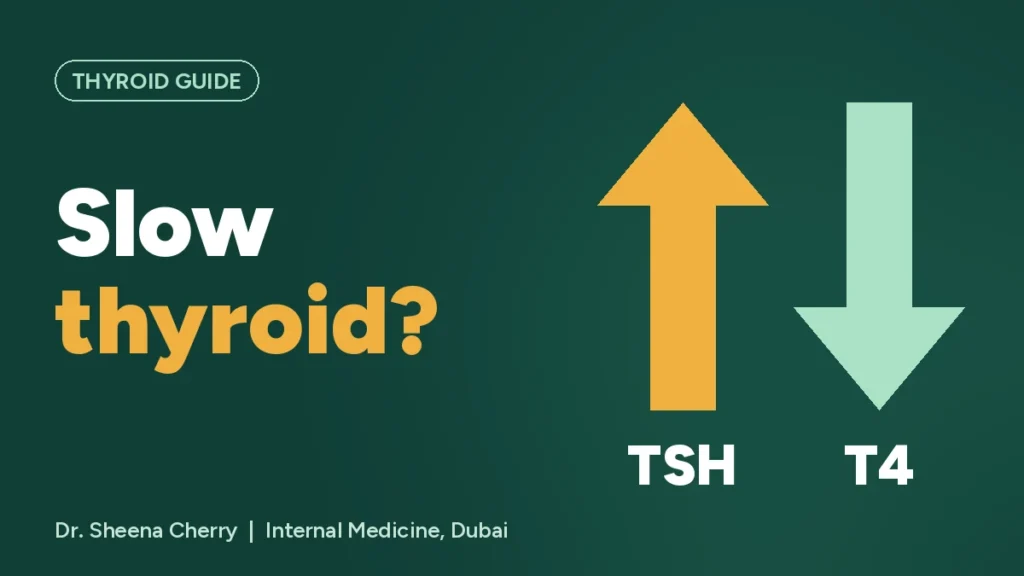
A high TSH usually points to an underactive thyroid. How high it is, and what your free T4 shows, decide what happens next, and many mildly raised results are simply rechecked. Pregnancy and existing thyroid treatment change how the result is read, so both have their own sections.
High TSH meaning: the short answer
- TSH (thyroid-stimulating hormone) is made by the pituitary gland to tell the thyroid to work harder.
- A high TSH usually means the thyroid is underactive (hypothyroidism), so the pituitary is pushing harder.
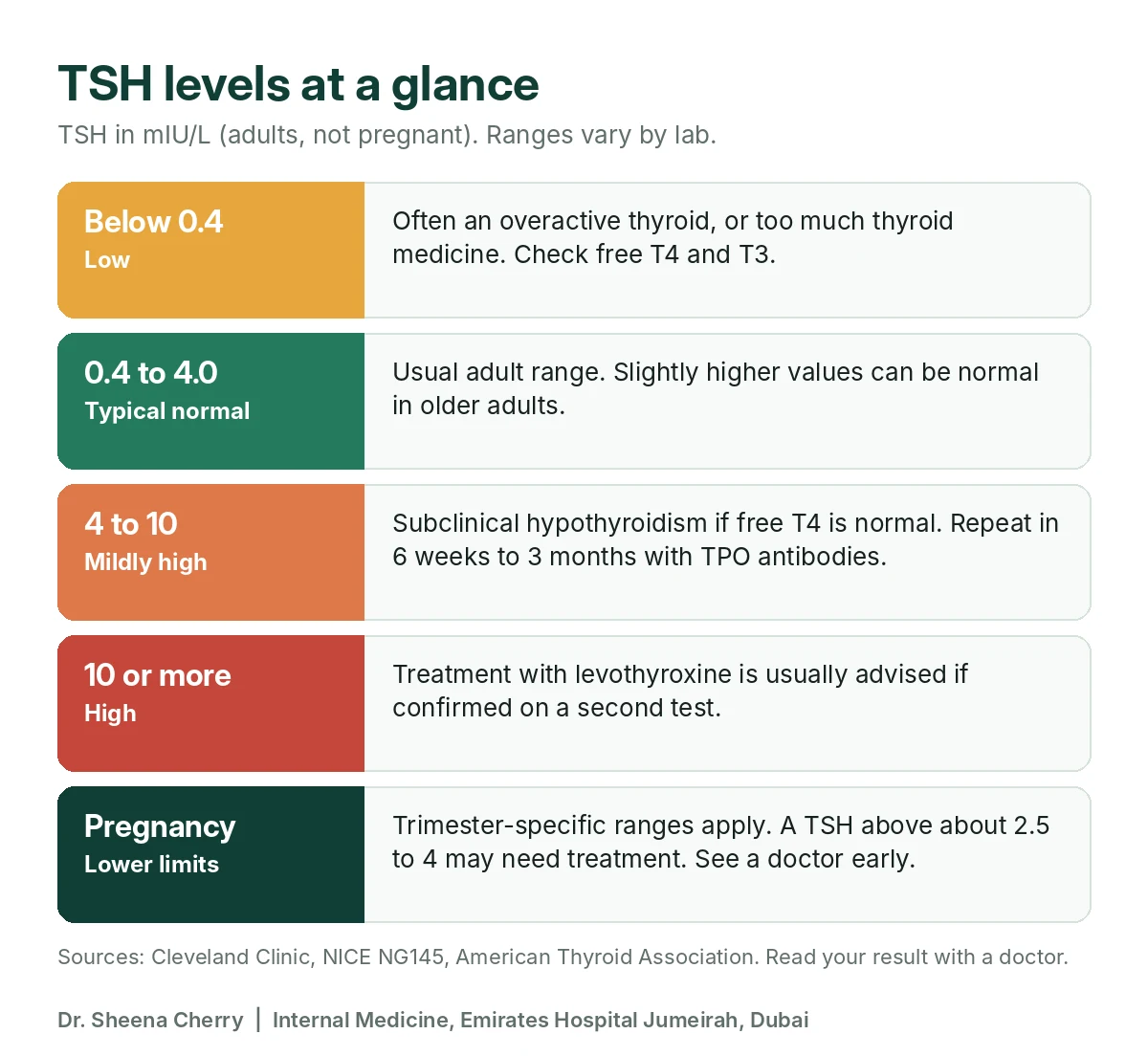
- Typical adult range: about 0.4 to 4.0 mIU/L. Labs differ slightly.
- A TSH between about 4 and 10 with a normal free T4 is called subclinical hypothyroidism. It is usually rechecked before any treatment.
- A TSH of 10 or more on two tests, or a high TSH with a low free T4, usually means treatment with levothyroxine.
In this guide: What TSH is · Normal range · What high TSH means · Causes · Symptoms · Next tests · Treatment · Pregnancy · FAQs
What is TSH?
Your thyroid is a small gland at the front of the neck. It makes two hormones, T4 and T3, that set the pace of your metabolism: how fast you burn energy, how warm you feel, your heart rate, bowel habit, mood and much more.
The thyroid does not decide on its own how much hormone to make. The pituitary gland at the base of the brain watches the level of thyroid hormone in the blood and releases TSH to adjust it. It works like a thermostat:
- When thyroid hormone is low, the pituitary turns up TSH to push the thyroid harder. TSH goes up.
- When thyroid hormone is high, the pituitary turns TSH down. TSH goes down.
So the TSH number moves in the opposite direction to how your thyroid is working. A high TSH points to an underactive thyroid, and a low TSH to an overactive one. TSH is also the most sensitive first test, because it changes before thyroid hormone levels move outside their own ranges.
TSH normal range
TSH is reported in mIU/L or µIU/mL. The two units give the same number. Typical ranges are below, but always use the range on your own report.
| Group | Typical TSH range |
|---|---|
| Adults | About 0.4 to 4.0 mIU/L (some labs use 0.27 to 4.2) |
| Older adults (over about 80) | The upper limit is often higher; a TSH up to 6 to 7 may be normal for age |
| Pregnancy, first trimester | About 0.18 to 2.99 mIU/L |
| Pregnancy, second trimester | About 0.11 to 3.98 mIU/L |
| Pregnancy, third trimester | About 0.48 to 4.71 mIU/L |
Ranges: Cleveland Clinic and American Thyroid Association. Pregnancy ranges vary between labs and populations.
What does a high TSH mean?
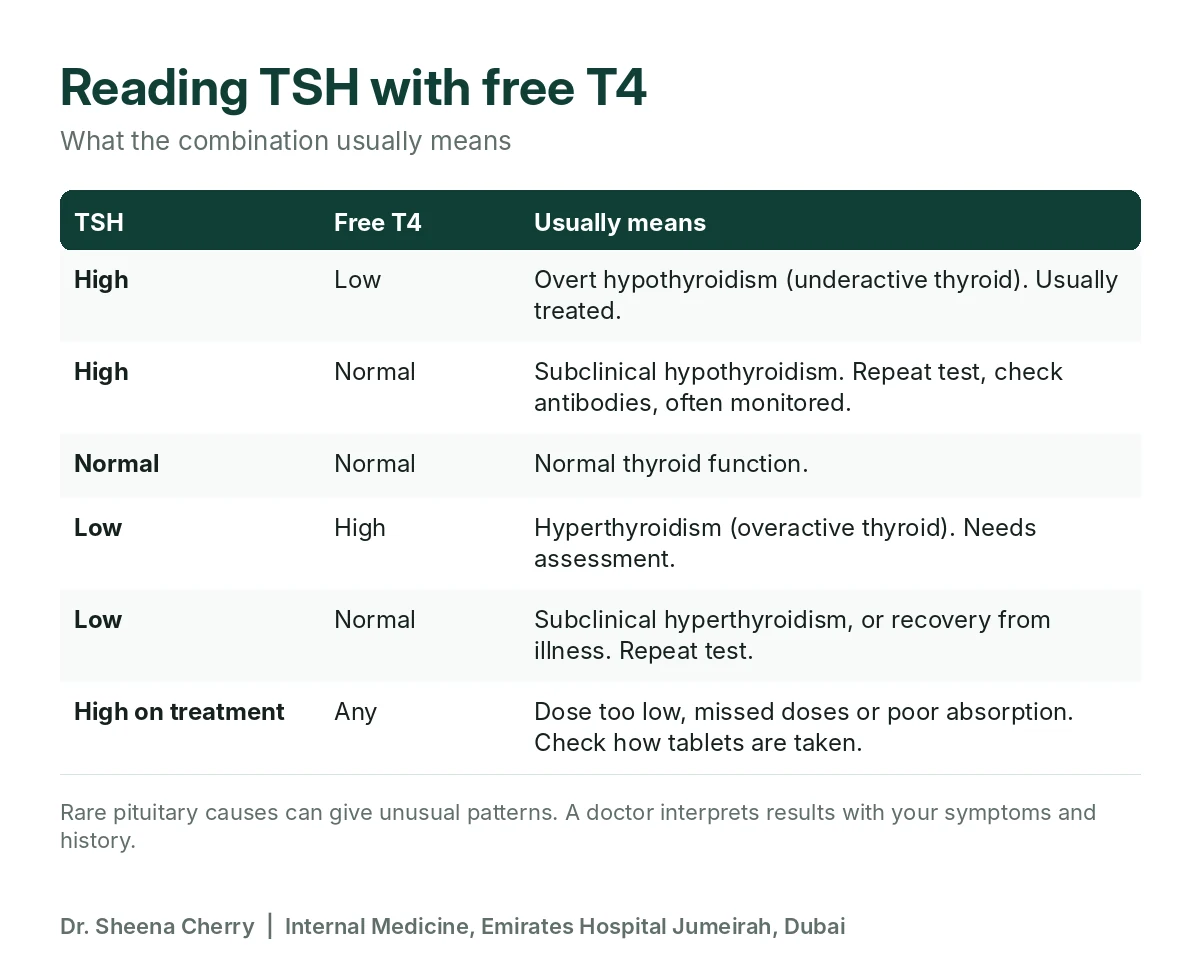
The meaning of a high TSH depends on two things: how high it is, and what your free T4 (the main thyroid hormone) shows at the same time.
High TSH with a low free T4: overt hypothyroidism
The thyroid is clearly not making enough hormone. This is a definite underactive thyroid and is usually treated with levothyroxine.
High TSH with a normal free T4: subclinical hypothyroidism
The pituitary is working harder to keep thyroid hormone in range. The word “subclinical” means the hormone level is still normal, not that you have no symptoms. Many people with a TSH in this range feel well. Some feel tired or low. It is common, particularly in women and older adults, and in some people it returns to normal on its own.
Mildly high TSH (about 4 to 10 mIU/L)
This is the most common situation in clinic. Usually the first step is to repeat the test after six weeks to three months, together with free T4 and thyroid antibodies, before deciding anything. A single mildly high result can be caused by a recent illness, the time of day or simple lab variation.
Clearly high TSH (10 mIU/L or more)
A TSH of 10 or more, confirmed on a second test, usually means the thyroid is struggling enough that treatment is advised, even if free T4 is still in range. UK NICE guidance suggests considering levothyroxine for adults with a TSH of 10 or more on two tests three months apart.
Very high TSH
Values of 50 or 100 mIU/L and above usually come with a low free T4 and clear symptoms. Most people with very high TSH are not in danger, but they need treatment promptly. In rare cases, severe untreated hypothyroidism can cause confusion, drowsiness, a low body temperature and a slow heart rate, which is an emergency.
High TSH results: three examples
These examples show how a doctor might read a high TSH. Your own results need a doctor’s review.
TSH 6.2 mIU/L, free T4 normal, feeling tired
This is mild subclinical hypothyroidism. The usual plan is to repeat TSH and free T4 with TPO antibodies in six weeks to three months, and to check other common causes of tiredness such as low iron, low vitamin D and poor sleep. If TSH stays raised and symptoms fit, a trial of levothyroxine may be discussed.
TSH 14 mIU/L, free T4 low
This is overt hypothyroidism. Treatment with levothyroxine is usually started, with a repeat TSH six to eight weeks later to adjust the dose. TPO antibodies often confirm Hashimoto’s as the cause.
TSH 8 mIU/L in someone already on levothyroxine
Before raising the dose, the doctor asks how the tablet is taken. Taking it with coffee or breakfast, or close to calcium or iron, is a common reason for a high TSH. Fixing the routine and rechecking in six to eight weeks often brings TSH back into range.
Common causes of high TSH
- Hashimoto’s thyroiditis. The most common cause in most parts of the world. The immune system slowly damages the thyroid. Positive TPO antibodies on a blood test support the diagnosis.
- After thyroid treatment. Surgery to remove part or all of the thyroid, radioactive iodine or radiotherapy to the neck.
- Thyroiditis recovery phase. After a viral thyroiditis or after pregnancy (postpartum thyroiditis), TSH can rise for a few months before settling.
- Recovery from a serious illness. TSH can rise for a short time while the body recovers, then return to normal.
- Medicines. Amiodarone, lithium, some cancer drugs and others can affect the thyroid.
- Iodine deficiency or excess. Less common where iodised salt is widely used, but still seen.
- Not enough levothyroxine. In people already on treatment, a high TSH usually means the dose is too low, doses are being missed or the tablet is not being absorbed well.
- Rare causes. A TSH-secreting pituitary tumour or thyroid hormone resistance. In these, free T4 is often high rather than low.
Symptoms of high TSH and an underactive thyroid
Symptoms come on slowly and are easy to blame on stress, age or a busy life:
- Tiredness and needing more sleep
- Feeling cold when others are comfortable
- Weight gain, usually modest
- Constipation
- Dry skin, brittle nails and thinning hair
- Low mood, poor concentration or memory
- Muscle aches, cramps or stiffness
- Heavier or irregular periods, and difficulty getting pregnant
- A puffy face, hoarse voice or slow pulse
- Raised cholesterol on a blood test
Having some of these does not prove a thyroid problem, and many of them overlap with low iron, low vitamin D and poor sleep, so the diagnosis rests on a blood test.
Can high TSH cause weight gain?
An underactive thyroid can cause some weight gain, mostly from fluid and a slower metabolism. It is usually a few kilograms, not a large amount. Treating the thyroid often helps a little, but it rarely reverses significant weight gain on its own. If weight is your main concern, a broader look at diet, sleep, blood sugar and activity is usually needed alongside the thyroid.
What to test after a high TSH
| Test | Why it helps |
|---|---|
| Repeat TSH | Confirms the result is persistent, usually after 6 weeks to 3 months |
| Free T4 | Separates overt from subclinical hypothyroidism |
| TPO antibodies | Positive in Hashimoto’s; predicts a higher chance of progressing to overt hypothyroidism |
| Free T3 | Not usually needed for an underactive thyroid |
| Cholesterol and full blood count | Hypothyroidism can raise cholesterol and is linked to anaemia |
| Thyroid ultrasound | Only if there is a lump, swelling or an unusual pattern |
Things that can affect your TSH result
- Time of day. TSH is naturally higher in the early morning. Testing at a similar time each time makes results easier to compare.
- Recent illness. TSH can be temporarily low during an illness and high during recovery.
- Biotin supplements. High-dose biotin, often taken for hair and nails, can interfere with some thyroid tests. Stopping it for a few days before the test is usually advised.
- Pregnancy. TSH falls in early pregnancy, so pregnancy-specific ranges are needed.
- Age. TSH rises naturally with age, so a mildly high result in an older person may be normal.
- Levothyroxine timing. If you take thyroid tablets, keep your routine the same before each test.
When is high TSH treated?
The decision is personal and depends on your numbers, symptoms, age, antibodies and plans for pregnancy. In general:
- Overt hypothyroidism (high TSH with low free T4) is treated.
- TSH of 10 or more on two tests is usually treated, even with a normal free T4.
- TSH above the range but below 10: often monitored. NICE guidance suggests a six-month trial of levothyroxine for adults under 65 who have symptoms, then stopping if it does not help.
- Older adults with a mildly raised TSH are often not treated, as it may be normal for their age.
- Pregnancy or planning pregnancy: a lower threshold for treatment is used, especially if TPO antibodies are positive.
How levothyroxine is taken
- Once a day, on an empty stomach, ideally 30 to 60 minutes before breakfast or at bedtime, at the same time each day.
- Keep coffee, milk, calcium, iron and antacids at least four hours away from the tablet, as they reduce absorption.
- TSH is rechecked about six to eight weeks after starting or changing the dose, then usually once a year when stable.
- Most people feel the benefit within a few weeks.
Learn more on our thyroid disorders page.
High TSH in pregnancy and when planning pregnancy
Thyroid hormone is important for the baby’s development, especially in the first trimester, when the baby relies on the mother’s supply. TSH normally falls in early pregnancy, so a value that would be fine outside pregnancy may be considered high.
- If you are planning pregnancy and have a raised TSH or positive TPO antibodies, see a doctor before you conceive.
- If you already take levothyroxine, contact your doctor as soon as you know you are pregnant. The dose often needs to go up.
- TSH is usually checked every four to six weeks in the first half of pregnancy if you are on treatment.
High TSH when you already take thyroid tablets
If you are on levothyroxine and your TSH is high, the usual reasons are:
- The dose is too low, for example after weight gain or as Hashimoto’s progresses
- Missed doses
- Taking the tablet with breakfast, coffee, calcium, iron or antacids
- A change in brand or formulation
- Pregnancy
- Gut conditions that reduce absorption, such as coeliac disease
These are worth checking before the dose goes up, because a change in routine often fixes the result.
TSH tests in Dubai: practical points
- Fasting: not needed for TSH alone.
- Timing: a morning test at a similar time each visit gives the most consistent results.
- Supplements: tell your doctor about biotin, iodine or “thyroid support” products.
- Ramadan: taking levothyroxine during Ramadan needs a planned routine. Ask your doctor before Ramadan starts.
- Insurance: thyroid tests requested by a doctor for symptoms are generally covered. Check your plan or call 800 444 444.
When to see a doctor
- Your TSH is above the range on your report
- You have symptoms of an underactive thyroid
- You are pregnant or planning pregnancy and have any thyroid result outside the range
- You take levothyroxine and your TSH is out of range
- You notice a lump or swelling in your neck
How Dr. Sheena Cherry can help
Dr. Sheena Cherry is a DHA-licensed Specialist in Internal Medicine at Emirates Hospital Jumeirah. In a consultation she reviews your thyroid results with your symptoms, medicines and earlier tests, arranges the right follow-up tests and agrees with you whether to monitor or treat. If you already take levothyroxine, she can check the dose and how you take it.
Frequently asked questions
What does it mean if my TSH is high?
It usually means your thyroid is underactive and the pituitary gland is releasing more TSH to push it harder. Your doctor will check free T4 and repeat the test to confirm.
What level of TSH is alarming?
A TSH of 10 mIU/L or more on repeat testing is usually treated. Very high levels, such as 50 or above, with a low free T4 need prompt treatment. Confusion, drowsiness or a very slow pulse with a high TSH is an emergency.
Is a TSH of 5 high?
It is slightly above most adult ranges. With a normal free T4, this is mild subclinical hypothyroidism. It is usually rechecked in a few weeks to months, along with thyroid antibodies, before deciding on treatment.
Can high TSH go back to normal on its own?
Yes. A mildly raised TSH after an illness, or during recovery from thyroiditis, often returns to normal, so a repeat test is usually done before starting treatment.
How can I reduce my TSH level?
If your thyroid is underactive, TSH comes down with the right dose of levothyroxine, taken correctly. There is no proven diet or supplement that lowers TSH, and iodine supplements can make some thyroid problems worse.
Will high TSH cause weight gain?
It can cause modest weight gain, often a few kilograms. Treatment may help a little, but other causes of weight gain usually need attention too.
Do I need to fast for a TSH test?
No. A morning test at a similar time each visit is ideal, and stop high-dose biotin for a few days beforehand if your doctor advises.
Is high TSH serious?
Most cases are mild and very treatable. Left untreated over years, a clearly underactive thyroid can raise cholesterol and affect the heart, mood and fertility, so it is worth assessing properly.
References
This guide is general information and does not replace a consultation. Read our medical disclaimer. For an emergency, call 998.
Specialist in Internal Medicine at Emirates Hospital Jumeirah, Dubai. MD in Internal Medicine, Fellowship in Critical Care Medicine and Postgraduate Certification in Cardiology from Johns Hopkins University. About Dr. Sheena