Internal Medicine vs General Practitioner: Which Doctor Should You See in Dubai?
 Dr. Sheena Cherry, Specialist in Internal Medicine
12 min read
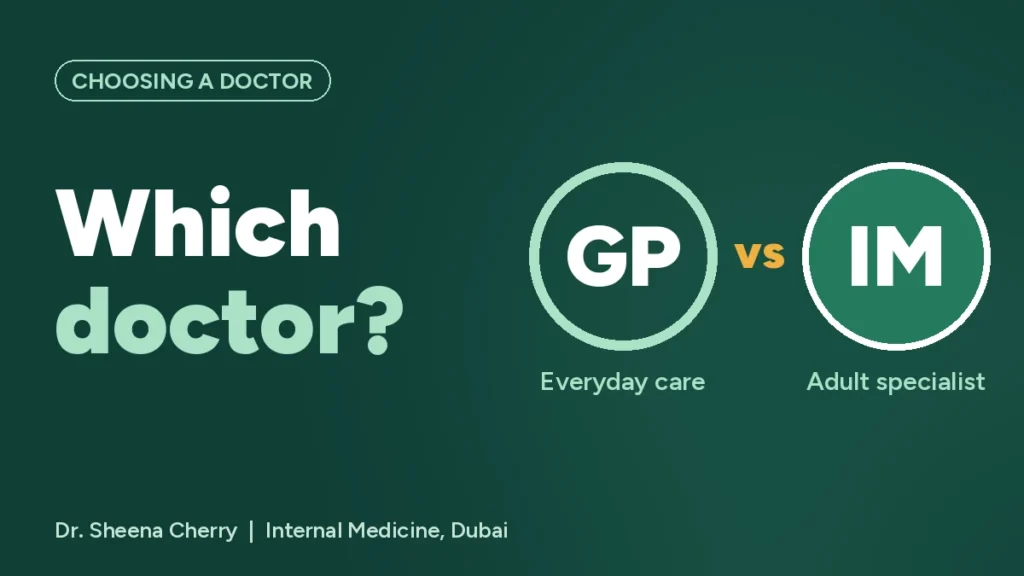
Your annual check shows high blood pressure, a borderline sugar result and a cholesterol number you do not understand. Or you have felt tired and unwell for months, and three different clinics have each looked at one symptom. Who should you see in Dubai: a general practitioner or an internal medicine specialist?
Both are doctors you can see first, but they are trained differently and suit different problems. In Dubai the choice also depends on how doctors are licensed and on your insurance plan, which may or may not need a GP referral before you see a specialist.
Internal medicine vs general practitioner: the short answer
- A general practitioner (GP) sees people of all ages for common, everyday problems and is often the first point of contact.
- An internal medicine specialist (internist) is a specialist in adult medicine, trained to diagnose difficult symptoms and manage long-term and multiple conditions together.
- See a GP for colds, minor injuries, children’s health, sick notes and routine prescriptions.
- See an internist for diabetes, high blood pressure, thyroid problems, anaemia, unexplained symptoms, abnormal test results or several conditions at once.
- In Dubai, an internist is licensed by the DHA as a Specialist or Consultant in Internal Medicine, which requires postgraduate specialty training.
In this guide: What a GP does · What an internist does · Side-by-side comparison · Family medicine · Which to choose · Internist or subspecialist · Insurance and referrals in Dubai · FAQs
What is a general practitioner?
A general practitioner is a doctor who provides first-contact care for a wide range of health problems, for patients of any age. In many countries the term means a doctor who has completed general practice or family medicine training. In Dubai, “General Practitioner” is also a licensing title used by the Dubai Health Authority (DHA) for doctors who are licensed to practise general medicine without a recognised specialty qualification.
GPs typically:
- Treat short-term illnesses such as colds, flu, sore throats, ear infections and stomach upsets
- Manage minor injuries and skin problems
- See children, adults and older people, often whole families
- Give vaccinations, routine health checks and sick-leave certificates
- Renew stable, routine prescriptions
- Refer patients to specialists when a problem needs more expertise
A GP is quick to see and a good first stop for everyday health problems.
What is an internal medicine specialist?
An internal medicine specialist, also called an internist or a specialist physician, is a doctor who specialises in the diagnosis and treatment of adults. The American College of Physicians describes internists as specialists who care for adults across the whole range from good health to complex illness, and notes that they are sometimes called “the doctor’s doctor” because other doctors ask them for help with difficult cases.
After medical school, internists complete a postgraduate training programme in internal medicine, usually lasting three years or more, much of it on hospital wards and in intensive care. This is where they learn to manage serious illness and several conditions at once. Subspecialists such as cardiologists, endocrinologists and gastroenterologists all start with this same internal medicine training.
Internists typically:
- Investigate symptoms that do not have an obvious cause, such as tiredness, weight loss, fever or breathlessness
- Manage long-term conditions: diabetes, high blood pressure, high cholesterol, thyroid disorders, anaemia, asthma and kidney problems
- Look after people living with several conditions and many medicines, checking that treatments work well together
- Interpret abnormal blood tests and scans
- Focus on prevention: screening, vaccines and lifestyle changes for adults
- Treat patients in clinic and in hospital, and coordinate care with other specialists
An internist is not the same as an “intern”. An intern is a newly qualified doctor in their first year of supervised practice. An internist is a fully trained specialist.
Internal medicine vs GP: side-by-side
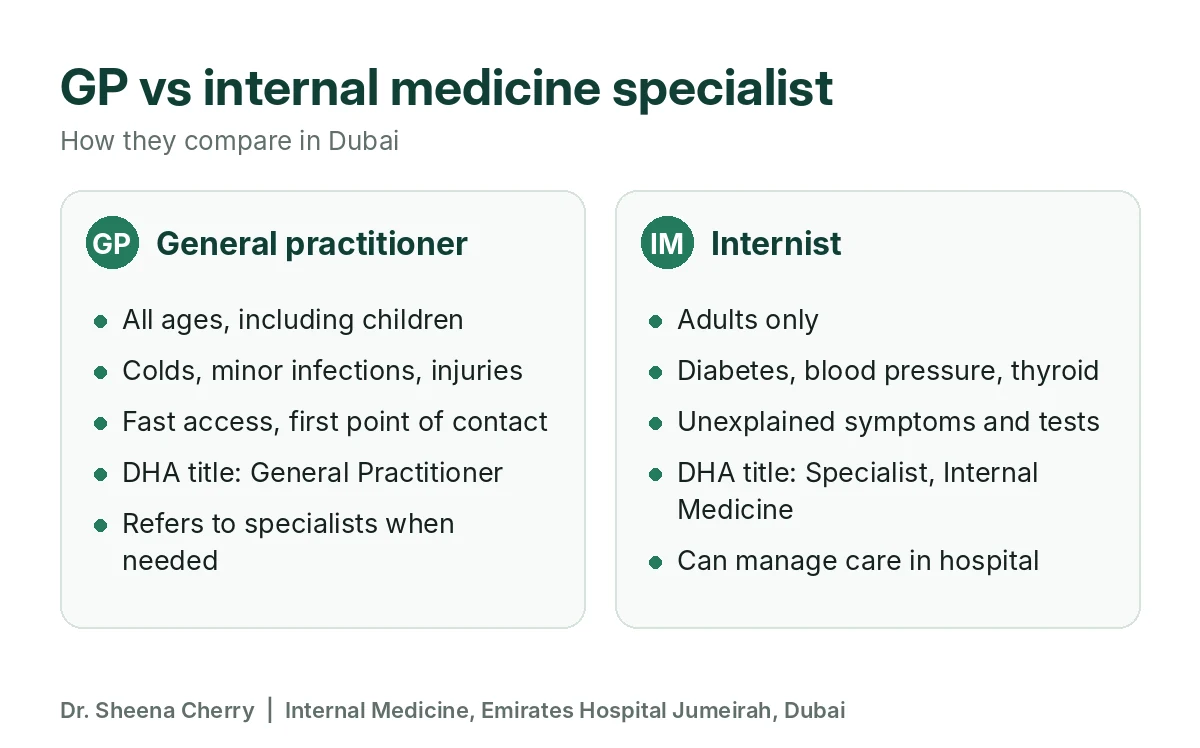
| General practitioner (GP) | Internal medicine specialist | |
|---|---|---|
| Patients | All ages, including children | Adults (usually 16 or 18 and over) |
| Training after medical school | Internship, with or without a general practice programme | Postgraduate specialty training in internal medicine, usually 3 years or more |
| DHA licence title | General Practitioner | Specialist or Consultant, Internal Medicine |
| Main strength | Breadth and fast access for common problems | Depth in adult disease, diagnosis and complex care |
| Typical problems | Colds, minor infections, injuries, routine checks | Chronic disease, several conditions at once, unexplained symptoms |
| Setting | Clinics and medical centres | Hospital clinics and wards |
| Hospital access | Refers when needed | Can admit and manage patients in hospital |
| Consultation fee | Usually lower | Usually higher, as a specialist fee |
Where does family medicine fit?
You will also see doctors in Dubai titled Specialist in Family Medicine. Family medicine is a specialty in its own right: these doctors complete postgraduate training in family medicine and care for people of every age, including children, women’s health and older adults. The American Academy of Family Physicians describes it as first-contact, continuing and comprehensive care for the whole person.
| General practitioner | Family medicine specialist | Internal medicine specialist | |
|---|---|---|---|
| Ages | All ages | All ages | Adults |
| Specialty training | Varies | Yes, in family medicine | Yes, in internal medicine |
| Best for | Everyday problems | Long-term care for the whole family | Complex adult illness and diagnosis |
A family medicine specialist goes wide across all ages, and an internist goes deep into adult medicine.
Which should you see?
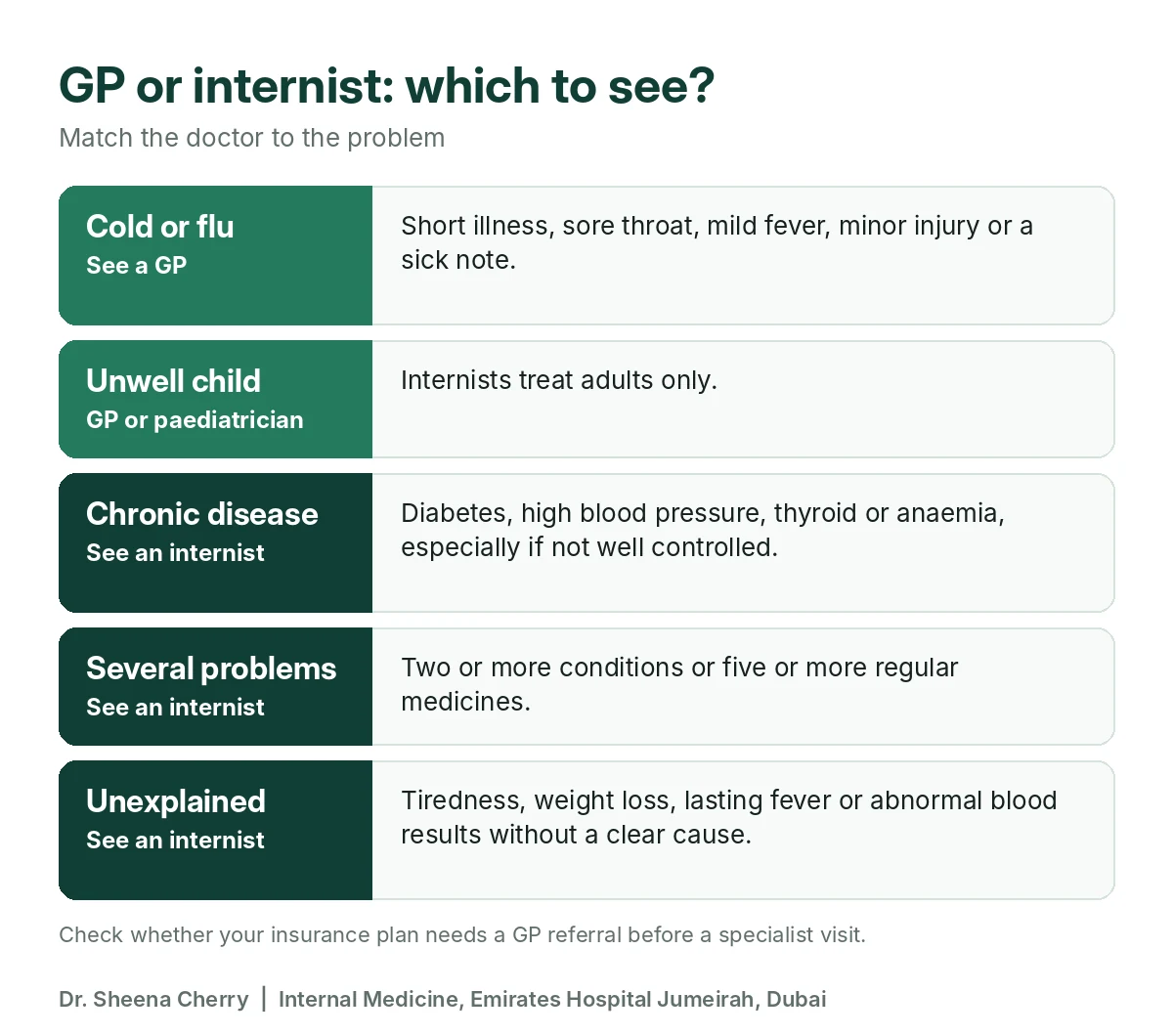
A GP is usually the right first stop if you have
- A cold, flu, sore throat or a short-lived fever
- A minor injury, rash or insect bite
- A child who is unwell
- A need for a vaccine, a sick note or a simple check-up
- A stable condition that only needs a repeat prescription
An internal medicine specialist is a better fit if you have
- Diabetes, high blood pressure, high cholesterol or a thyroid problem, especially if it is not well controlled
- Two or more long-term conditions, or five or more regular medicines
- Symptoms without a clear cause: tiredness, weight loss, dizziness, a fever that will not go away, breathlessness or recurring stomach problems
- Abnormal blood results that need explaining, such as a blood count, HbA1c, liver or kidney test
- A recent hospital stay, or recovery from an illness such as COVID-19 that has left lasting symptoms
- Been told by your GP that you need specialist review
Symptoms an internist commonly investigates
| Symptom | Possible causes an internist looks for |
|---|---|
| Tiredness for weeks | Anaemia, low iron, thyroid problems, diabetes, vitamin D or B12 deficiency, sleep problems, depression |
| Weight loss without trying | Overactive thyroid, diabetes, gut conditions, infections such as TB, cancer |
| Breathlessness | Anaemia, heart failure, asthma, lung disease, being out of condition after illness |
| Dizziness or fainting | Low blood pressure, medicine side effects, dehydration, heart rhythm problems, anaemia |
| Recurring stomach pain or bloating | Reflux, gastritis, irritable bowel syndrome, gallstones, coeliac disease |
| Swollen ankles | Heart, kidney or liver problems, medicines, vein problems |
An internist reads these clues together, because one result on its own rarely explains a symptom.
Four everyday examples
These show how the choice usually plays out. Your own situation may differ.
A 6-year-old with an earache
A GP, family medicine doctor or paediatrician. Internists do not usually see children.
A 29-year-old with a cold for two days
A GP. It is quick, simple and the right level of care.
A 52-year-old with diabetes, high blood pressure and a rising kidney test
An internist. These conditions affect each other, and the medicines need to be chosen together to protect the heart and kidneys.
A 40-year-old who has felt exhausted for three months, with low iron and a borderline thyroid result
An internist. Finding the reason means looking at the whole picture, including ferritin, thyroid tests, diet, sleep and other causes, rather than treating each result on its own.
Which is better, internal medicine or a GP?
Neither is better in general. They are built for different jobs. A GP gives fast, broad care for everyday problems and for the whole family. An internist gives deeper care for adult illness, especially when problems are complex, long term or unclear. Many people do well with both: a GP for day-to-day needs and an internist for chronic conditions or difficult diagnoses.
Picking the wrong one mostly costs time and money. Seeing a specialist for a simple cold costs more than it needs to. Seeing only a GP for poorly controlled diabetes with heart and kidney risks can mean months before the right specialist plan is in place.
Internist or subspecialist?
If you have heart disease, should you see a cardiologist instead? Sometimes. Subspecialists such as cardiologists, endocrinologists, nephrologists and gastroenterologists are internists who trained further in one organ system. They are the right choice for advanced or specialised problems, such as a heart rhythm procedure or complex hormone disorders.
But many problems sit across several systems. Diabetes affects the heart, kidneys, eyes and nerves. Tiredness can come from the blood, thyroid, gut, heart or mood. An internist looks at all of these at once, treats most of them directly, and brings in a subspecialist only when it adds something. This avoids seeing four doctors who each look at one part of you.
Insurance and referrals in Dubai
- Direct access: many health insurance plans in Dubai let you book a specialist directly, without a GP referral.
- Referral plans: some plans, particularly basic plans, need a GP referral before a specialist visit is covered. Check your policy or ask the hospital’s insurance desk before booking.
- Fees: specialist consultations usually cost more than GP visits. Your co-payment may also differ.
- Follow-up: once you are under an internist’s care for a long-term condition, regular follow-up visits are usually booked directly with them.
How to choose a doctor in Dubai
- Check the licence and title. Every doctor in Dubai must hold a DHA licence. The title (General Practitioner, Specialist or Consultant) and specialty are part of that licence.
- Look at their focus. Ask whether they regularly treat your condition.
- Consider hospital access. A doctor based in a hospital can arrange scans, specialist opinions and admission quickly if needed.
- Language and communication. You should leave the room understanding your plan.
- Continuity. For long-term conditions, seeing the same doctor over time leads to better decisions.
How to prepare for your first internal medicine appointment
- Bring recent blood tests, scan reports and hospital letters, even from other countries
- Bring all your medicines and supplements, or clear photos of the boxes
- Write down your main concern and when it started
- Note family history of diabetes, heart disease, thyroid problems or cancer
- Write your top three questions so none get missed
Common myths
- “Internists only work in hospitals.” Many see outpatients in clinics, just like a GP, but with hospital support behind them.
- “An internist is a junior doctor.” That is an intern. An internist is a trained specialist.
- “You always need a referral to see a specialist in Dubai.” It depends on your insurance plan. Many allow direct booking.
- “A GP can’t manage chronic disease.” Many GPs manage stable chronic conditions very well. An internist adds most value when control is poor, several conditions overlap or the diagnosis is unclear.
How Dr. Sheena Cherry can help
Dr. Sheena Cherry is a DHA-licensed Specialist in Internal Medicine at Emirates Hospital Jumeirah, Jumeirah Beach Road, Dubai. She sees adults for diabetes, high blood pressure, thyroid disorders, anaemia, digestive problems, weight management, healthy ageing, infections and post-COVID recovery, and for symptoms that have not yet been explained. Read more about Dr. Sheena Cherry or see the full list of conditions treated.
Frequently asked questions
Is internal medicine the same as a general practitioner?
No. A GP treats people of all ages for common problems. An internal medicine specialist has postgraduate training in adult medicine and focuses on diagnosis and long-term, complex conditions in adults.
Which is better, an internist or a GP?
Neither is better overall. A GP is ideal for everyday illness and family care. An internist is a better fit for chronic disease, several conditions at once or symptoms without a clear cause.
Can an internal medicine doctor be my main doctor?
Yes. Many adults use an internist as their regular doctor, especially if they have long-term conditions. Children will still need a GP, family doctor or paediatrician.
Do internal medicine doctors treat children?
Usually not. Internists care for adults. Children are seen by paediatricians, family medicine doctors or GPs.
Do I need a referral to see an internal medicine specialist in Dubai?
It depends on your insurance plan. Many plans allow direct booking, while some basic plans need a GP referral. Check with your insurer or the hospital before booking.
What is the difference between internal medicine and family medicine?
Both are specialties with postgraduate training. Family medicine covers all ages, including children and pregnancy care. Internal medicine focuses only on adults, with more depth in complex adult illness.
Is an internist a specialist?
Yes. In Dubai, internists are licensed by the DHA as Specialists or Consultants in Internal Medicine.
What is the difference between an internist and an intern?
An intern is a newly graduated doctor in a first year of supervised training. An internist is a fully trained specialist in internal medicine.
Is an internal medicine consultation more expensive than a GP visit?
Usually, yes, because it is charged as a specialist consultation. Your insurance co-payment may also differ. Ask the clinic or your insurer for exact costs.
What happens at a first internal medicine appointment?
Expect a detailed history, a review of your medicines and past results, a full examination and a plan, which may include blood tests or scans. Bring your reports and medicine list to make the most of it.
References
This guide is general information and does not replace a consultation. Read our medical disclaimer. For an emergency, call 998.
Specialist in Internal Medicine at Emirates Hospital Jumeirah, Dubai. MD in Internal Medicine, Fellowship in Critical Care Medicine and Postgraduate Certification in Cardiology from Johns Hopkins University. About Dr. Sheena