Vitamin D Deficiency in the UAE: Causes, Levels, Symptoms and Treatment
 Dr. Sheena Cherry, Specialist in Internal Medicine
14 min read
The UAE has around ten hours of sunshine a day, yet “your vitamin D is low” is one of the most common things people hear after a routine blood test here. Some people feel tired or achy and wonder if this is why. Others feel fine and are unsure whether to take a supplement, how much, and for how long.
The heat is a large part of the reason. For much of the year people stay indoors when the sun is strongest, so the skin makes little vitamin D, and few foods contain much of it. Low levels are easy to correct, but the dose and the follow-up matter.
Vitamin D deficiency in the UAE: the short answer
- Vitamin D deficiency is very common in the UAE. A 2025 review of UAE studies found an average level of about 17.6 ng/mL in healthy adults, below the usual cut-off of 20 ng/mL.
- The main reasons are avoiding the sun because of heat, covering clothing, indoor lifestyles, darker skin and few vitamin D foods.
- Most labs report below 20 ng/mL (50 nmol/L) as deficient and below 12 ng/mL (30 nmol/L) as severely low.
- Many people have no symptoms. When present, they include bone pain, muscle aches and weakness, and tiredness.
- Treatment is safe and simple under medical guidance, but very high doses without monitoring can cause harm.
In this guide: Why it is common in the UAE · Vitamin D levels explained · Symptoms · Who is at risk · Who should be tested · Treatment · Sun and food in the UAE · FAQs
What does vitamin D do?
Vitamin D helps your body absorb calcium and phosphate from food. These minerals keep bones and teeth strong and help muscles work properly. Without enough vitamin D, the body takes calcium from the bones, which over time can soften them (osteomalacia in adults, rickets in children) and add to bone thinning (osteoporosis).
Vitamin D also plays a part in muscle strength and the immune system. It has been studied for links with diabetes, heart disease, infections and mood, but for most of these the evidence that supplements prevent disease is limited.
Your skin makes most of your vitamin D when it is exposed to UVB sunlight. Smaller amounts come from food and supplements.
Why is vitamin D deficiency so common in the UAE?
It seems surprising in a country with so much sun, but research from the UAE points to the same reasons again and again:
- Heat and sun avoidance. For much of the year it is too hot to spend time outdoors in the middle of the day, when UVB is strongest. Life moves between air-conditioned homes, cars, offices and malls.
- Clothing. Traditional and modest clothing covers most of the skin, which limits how much vitamin D the body can make.
- Skin tone. Darker skin needs more sun exposure to make the same amount of vitamin D.
- Sunscreen and shade. Both protect against skin damage but also reduce vitamin D production.
- Diet. Few foods are naturally rich in vitamin D, and oily fish is not eaten often by many people.
- Weight. Vitamin D is stored in body fat, so people living with obesity often have lower blood levels. Obesity is common in the UAE.
A 2025 systematic review of studies in healthy UAE residents found a pooled average vitamin D level of about 17.6 ng/mL in adults, which falls in the deficient range. Earlier UAE studies have reported deficiency in roughly half or more of the adults tested, across nationalities and in both men and women.
Vitamin D levels explained
The blood test measures 25-hydroxyvitamin D, often written as 25(OH)D. Labs in the UAE report it in ng/mL or nmol/L. To convert, multiply ng/mL by 2.5 to get nmol/L.
| Level (ng/mL) | Level (nmol/L) | What it usually means |
|---|---|---|
| Below 12 | Below 30 | Severely low. Higher risk of bone and muscle problems. Treatment needed. |
| 12 to 19 | 30 to 49 | Deficient for most people. Treatment usually advised. |
| 20 to 29 | 50 to 74 | Adequate for most healthy people. Some labs call this “insufficient”. |
| 30 to 50 | 75 to 125 | Adequate. Many labs show this as the target range. |
| Above 50 | Above 125 | Higher than needed. Review your supplement dose. |
| Above 100 | Above 250 | Too high. Risk of toxicity, usually from supplements. |
Based on the US National Institutes of Health Office of Dietary Supplements and common lab reference ranges. Experts do not fully agree on the ideal level, so ranges vary between labs.
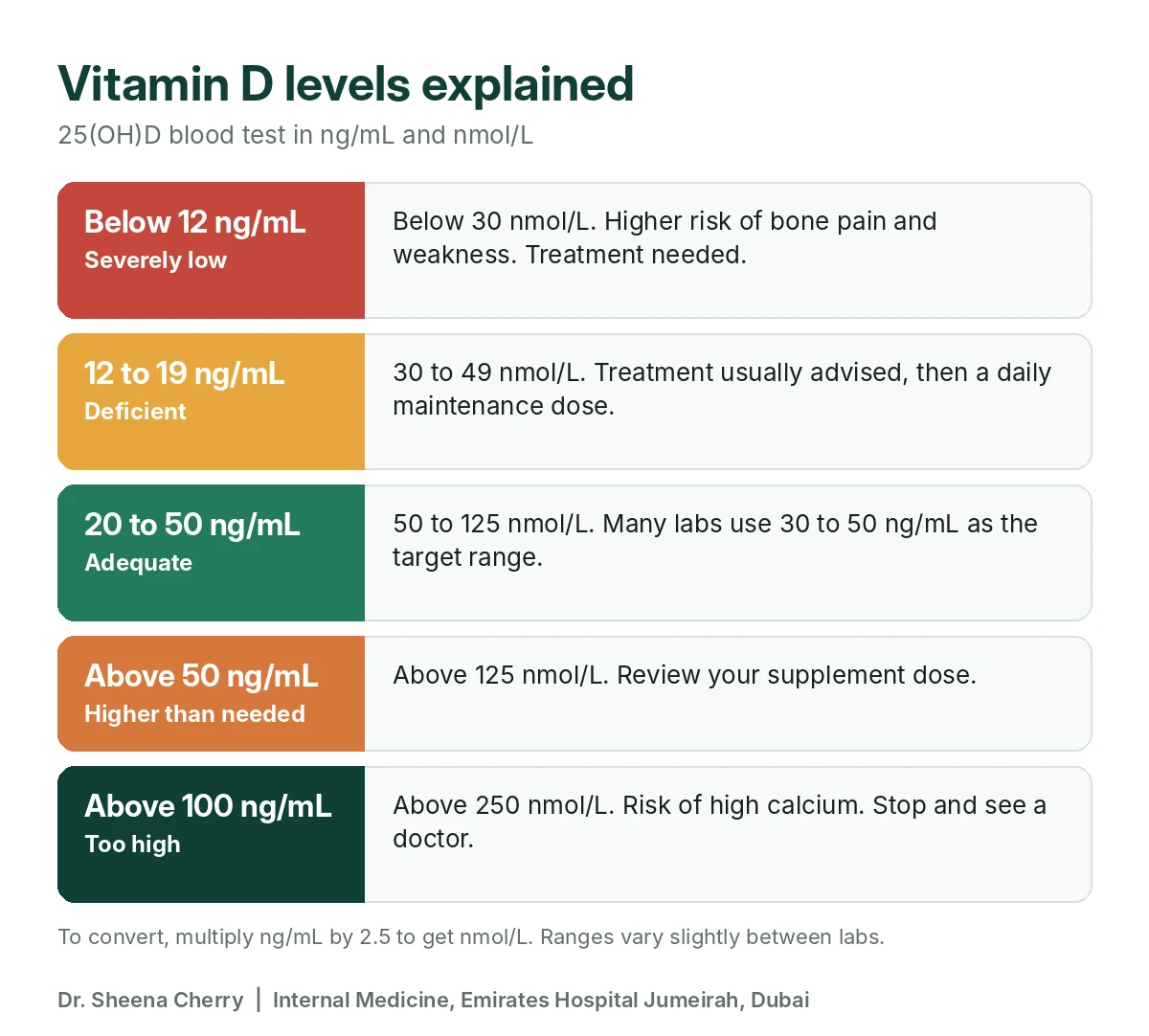
Guidelines disagree on the target. Some treat 30 ng/mL or above as the goal, while others, including the US Institute of Medicine, consider 20 ng/mL enough for bone health in most people. The Endocrine Society’s 2024 guideline found that the evidence was not strong enough to set a single target level. In practice, your doctor will look at your number alongside your bones, symptoms and risk factors.
Symptoms of vitamin D deficiency
Most people with mild or moderate deficiency have no symptoms at all, so it is often found on a routine test. When symptoms appear, they usually develop slowly:
- Aching bones, especially in the lower back, hips, legs and ribs
- Muscle aches, cramps and weakness, such as difficulty climbing stairs or getting up from a chair
- Tiredness and low energy
- Frequent falls in older adults
- Fractures after minor falls
- In children, delayed growth, bowed legs and slow tooth development
Tiredness has many causes. Low iron, anaemia, thyroid problems, poor sleep and diabetes are all common in the UAE and can feel the same. If you are tired, a doctor will usually check more than vitamin D. Our guides to ferritin, the blood count and thyroid tests explain those results.
Five signs worth checking
- Bone or back pain without an injury
- Muscle weakness in the thighs or shoulders
- Getting tired much more easily than before
- A fracture from a simple fall
- Low calcium or high parathyroid hormone on a blood test
Who is most at risk in the UAE?
- People who spend most of the day indoors, including office workers and night-shift workers
- Women who wear covering clothing
- People with darker skin
- People living with obesity, or after bariatric surgery
- Pregnant and breastfeeding women, and breastfed babies
- Older adults, whose skin makes less vitamin D
- People with gut conditions that reduce absorption, such as coeliac disease or inflammatory bowel disease
- People with kidney or liver disease
- People taking certain medicines, such as some anti-seizure drugs, long-term steroids and some HIV medicines
Should everyone be tested?
Not necessarily. The Endocrine Society’s 2024 guideline advises against routine vitamin D testing in healthy adults under 75 who have no specific reason for it. In those groups, following the standard daily intake is usually enough.
Testing is more useful if you have:
- Bone pain, muscle weakness, osteoporosis or a fracture after a minor fall
- Low calcium, high parathyroid hormone or a raised alkaline phosphatase on blood tests
- A condition that affects absorption, or a history of bariatric surgery
- Chronic kidney or liver disease
- Medicines that lower vitamin D
- Been on high-dose treatment and need a follow-up level
In practice, many people in the UAE are tested as part of health checks because deficiency is so common here. If your result is low, the next step is a treatment plan.
Reading your result: four examples
These illustrate how a doctor might read a result. Your own results need a doctor’s review.
8 ng/mL (20 nmol/L) with aching legs
Severely low, with symptoms. A doctor would usually check calcium, phosphate, alkaline phosphatase, parathyroid hormone and kidney function, start a treatment course and recheck in about three months.
16 ng/mL (40 nmol/L) with no symptoms
Deficient. A treatment course followed by a daily maintenance dose is common, along with sensible sun and diet changes.
26 ng/mL (65 nmol/L)
Adequate for most people. A standard daily supplement may be suggested, especially in the UAE where levels tend to fall without one.
110 ng/mL (275 nmol/L) on high-dose capsules
Too high. The supplement is stopped, calcium is checked and the dose is reviewed. High-dose treatment should always come with follow-up tests.
How is vitamin D deficiency treated?
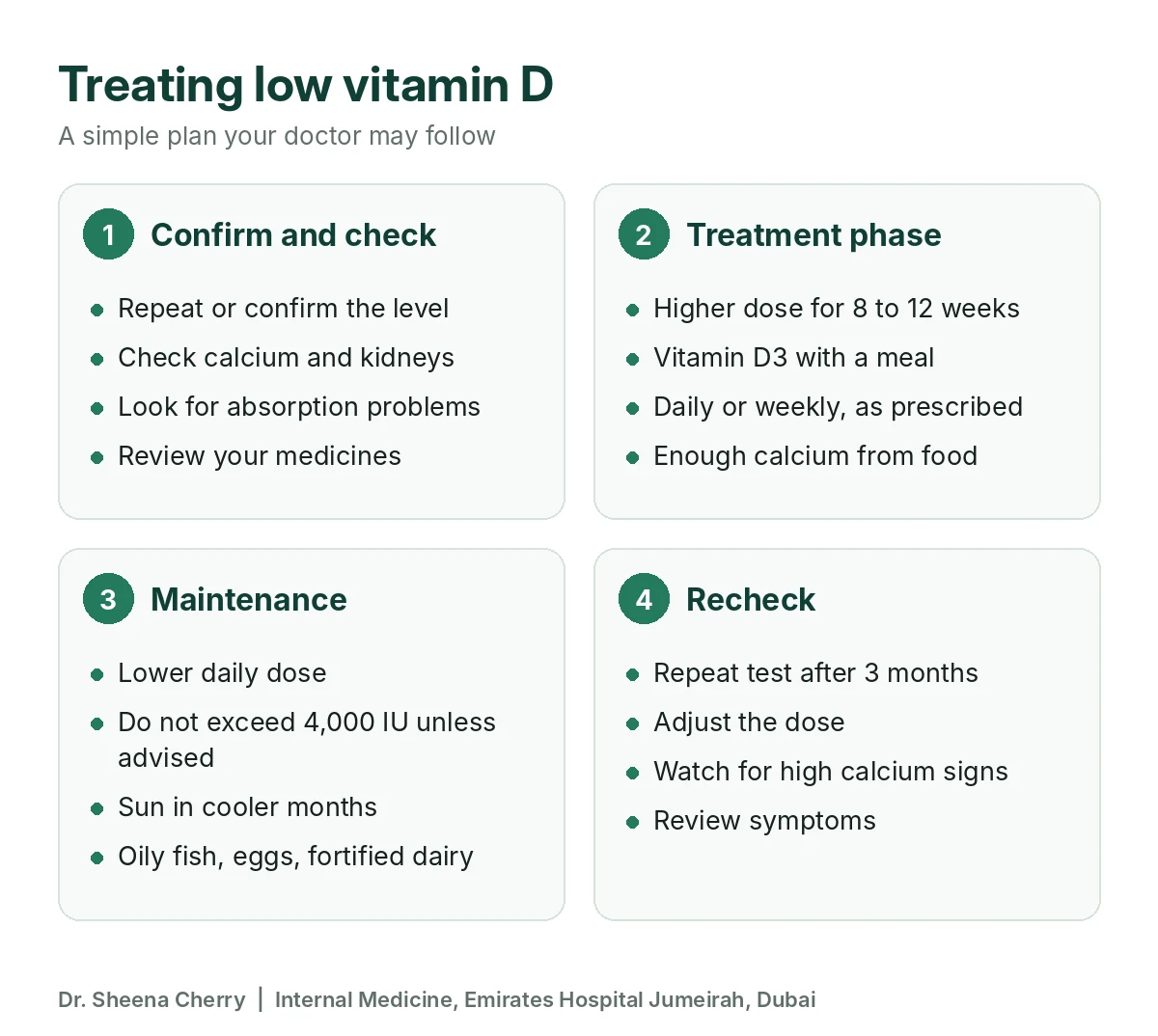
Treatment depends on how low your level is, your weight, your other health conditions and the medicines you take. It usually has two stages:
- Treatment phase: a higher dose for several weeks, often 8 to 12, to bring the level up. This may be daily or weekly capsules, tablets or drops, as prescribed.
- Maintenance phase: a lower daily dose to keep the level up, because deficiency often returns once supplements stop.
Vitamin D3 (cholecalciferol) is the form most often used. Taking it with a meal that contains some fat helps absorption. Your doctor may also check that you get enough calcium from food or recommend a calcium supplement if needed.
A repeat test is usually done after about three months of treatment to make sure the level has improved and is not too high.
How much vitamin D do you need each day?
| Group | Recommended daily intake | Upper limit (without medical advice) |
|---|---|---|
| Adults 19 to 70 | 600 IU (15 mcg) | 4,000 IU (100 mcg) |
| Adults over 70 | 800 IU (20 mcg) | 4,000 IU (100 mcg) |
| Pregnant and breastfeeding women | 600 IU (15 mcg) | 4,000 IU (100 mcg) |
Source: US National Institutes of Health Office of Dietary Supplements. Treatment doses for deficiency are higher and should be prescribed and monitored by a doctor.
Can you take too much vitamin D?
Yes. Vitamin D toxicity is rare but real, and almost always caused by supplements, not sun or food. Taking very high doses for months can raise calcium in the blood, causing nausea, vomiting, thirst, confusion, kidney stones and, in severe cases, kidney damage and heart rhythm problems. Avoid stacking several products that each contain vitamin D, and do not take high-dose injections or capsules without a plan for follow-up testing.
Getting vitamin D from sun and food in the UAE
Sunlight
- Your skin makes vitamin D from UVB light, which is strongest around the middle of the day.
- In the cooler months, roughly November to March, short periods outdoors with your arms and legs uncovered, a few times a week, can help. People with darker skin need longer.
- In the hot summer months, midday sun is not safe for long periods. Rely more on food and supplements, and avoid heat exhaustion.
- Glass blocks UVB, so sitting by a sunny window or in a car does not help.
- Never let your skin burn. Sunburn increases the risk of skin cancer.
Food
- Oily fish: salmon, sardines, mackerel and tuna
- Egg yolks
- Fortified milk, laban, yoghurt, juices and breakfast cereals (check the label)
- Mushrooms exposed to UV light
- Beef liver, in small amounts
Food alone rarely provides enough vitamin D, which is why many people in the UAE need a supplement, especially in summer.
Vitamin D and other health conditions
- Bones and falls: correcting deficiency protects against osteomalacia. In older adults, vitamin D with enough calcium supports bone health as part of a wider plan for healthy ageing.
- Prediabetes: the 2024 Endocrine Society guideline suggests vitamin D supplements may modestly lower the chance of prediabetes progressing to diabetes. Weight loss and activity remain the main steps (see our guide to HbA1c levels).
- Weight: people living with obesity often need higher doses to raise their level. Our weight management page explains how we support weight loss.
- Gut conditions: poor absorption can keep levels low despite supplements. Ongoing digestive symptoms are worth checking.
Common myths
- “I live in the UAE, so I can’t be low.” Deficiency is common here precisely because the heat keeps people indoors.
- “More is better.” Above a certain level there is no extra benefit, and very high levels are harmful.
- “One injection fixes it for good.” Levels fall again without maintenance.
- “Vitamin D explains all my tiredness.” It may be part of the picture, but other causes need checking.
When to see a doctor
- Your vitamin D is below 20 ng/mL (50 nmol/L)
- You have bone pain, muscle weakness or a fracture after a minor fall
- You are pregnant or planning pregnancy and have low vitamin D
- Your level stays low despite taking supplements
- You have been taking high doses for more than a few months without a repeat test
- You feel tired and unwell and are not sure why
How Dr. Sheena Cherry can help
Dr. Sheena Cherry is a DHA-licensed Specialist in Internal Medicine at Emirates Hospital Jumeirah, Dubai. She treats vitamin D deficiency as part of a full check: confirming the result, looking for causes such as absorption problems or medicines, checking calcium, bones and related tests, and ruling out other reasons for tiredness and aches such as iron deficiency or thyroid problems. You get a clear dose, a plan for how long to take it and a date to recheck.
Frequently asked questions
Why is vitamin D deficiency common in the UAE despite the sun?
Because the heat keeps most people indoors in the middle of the day, clothing covers much of the skin, darker skin needs more sun, and diets contain few vitamin D foods. Obesity, which is common, also lowers blood levels.
What is a normal vitamin D level?
Most labs consider 20 ng/mL (50 nmol/L) or higher adequate for most people, and many show 30 to 50 ng/mL (75 to 125 nmol/L) as the target range. Below 20 ng/mL is usually called deficient.
What are the five signs of vitamin D deficiency?
Common signs are bone or back pain, muscle weakness or cramps, tiredness, frequent falls in older adults and fractures after minor injuries. Many people have no symptoms.
How can I get vitamin D in the UAE?
Short periods of sun on the arms and legs in the cooler months, foods such as oily fish, egg yolks and fortified dairy, and a daily supplement if advised by your doctor, especially during summer.
How long does it take to correct vitamin D deficiency?
Levels usually rise within 8 to 12 weeks of treatment. Symptoms such as bone and muscle aches can take a few months to improve. A maintenance dose is often needed afterwards.
Is it safe to take vitamin D every day?
Yes, at the recommended dose. Adults should not take more than 4,000 IU a day long term unless a doctor prescribes it and monitors the level.
Can low vitamin D cause tiredness?
It can contribute, especially when the level is very low. But tiredness has many causes, including anaemia, low iron, thyroid problems and poor sleep, so these should be checked too.
Should I take vitamin D with calcium?
Only if you do not get enough calcium from food, or your doctor advises it. Dairy, leafy greens, almonds and fortified foods provide calcium for most people.
Do I need a vitamin D test every year?
Not usually. A repeat test is useful about three months after starting treatment, or if symptoms continue. Healthy adults on a standard daily dose rarely need yearly testing.
Is vitamin D deficiency serious?
Mild deficiency is usually easy to correct. Severe, long-standing deficiency can soften bones, cause pain and weakness and increase fracture risk, so it should be treated.
References
- NIH Office of Dietary Supplements. Vitamin D fact sheet for health professionals
- Endocrine Society. Vitamin D for the prevention of disease, clinical practice guideline 2024
- Frontiers in Nutrition 2025. Vitamin D levels in healthy individuals in the UAE: systematic review and meta-analysis
- Gariballa S, et al. Vitamin D deficiency in community free living adults, Al Ain, UAE. BMC Endocr Disord 2022
- NHS. Vitamin D
This guide is general information and does not replace a consultation. Read our medical disclaimer. For an emergency, call 998.
Specialist in Internal Medicine at Emirates Hospital Jumeirah, Dubai. MD in Internal Medicine, Fellowship in Critical Care Medicine and Postgraduate Certification in Cardiology from Johns Hopkins University. About Dr. Sheena